Affichage des articles dont le libellé est Seguridad alimentaria (food security). Afficher tous les articles

07/04/2022

FOOD LAW - China: Talking about the National Food Security Standard


National Food Security Standard (hereinafter referred to as the “National Standard”) is crucial to anyone who works in the food industry. However, many people are not clear about the classification of National Standard, which is important to foreign exporters.


Let’s start with the Food Safety Law, which is the fundamental law of food safety. According to the Food Safety Law, Chapter 3 Food Safety Standards, Article 25: 

Food safety standards shall be standards for mandatory execution. No mandatory food standards other than food safety standards may be developed. 

Article 26. Food safety standards shall contain: 

✔ limits of pathogenic microorganisms, pesticide residues, residues from veterinary medicines, biological toxins, heavy metals, and other pollutants, and other substances hazardous to human health in food, food additives, and food-related products; 

✔ varieties, range of application, and dosages of food additives; 

✔ nutritional composition requirements for staple and supplementary food exclusively for infants and other particular groups of people 

✔ requirements for labels, marks, and instructions related to health, nutrition, and other food safety requirements; 

✔ hygienic requirements for the process of food production or trade; 

✔ quality requirements related to food safety; 

✔ food inspection methods and procedures related to food safety; and 

✔ others which need to be developed into food safety standards. 

Obviously, the upper rank law has provided a clear position and scope for the national standard of food safety, so next step we will explain in detail the specific classification of national standards. 


The first category is common criteria 

Common criteria refer to standards that are widely used and have broad guiding significance as the basis of other standards within a certain range. 

In another word, all food products, no matter what category they belong to, shall comply with the common criteria. 

For example, if there is no corresponding food product standard for a food product imported from abroad, you can find the corresponding common criteria according to the food category of the product and comply with the safety requirements for the food category in the standard. 

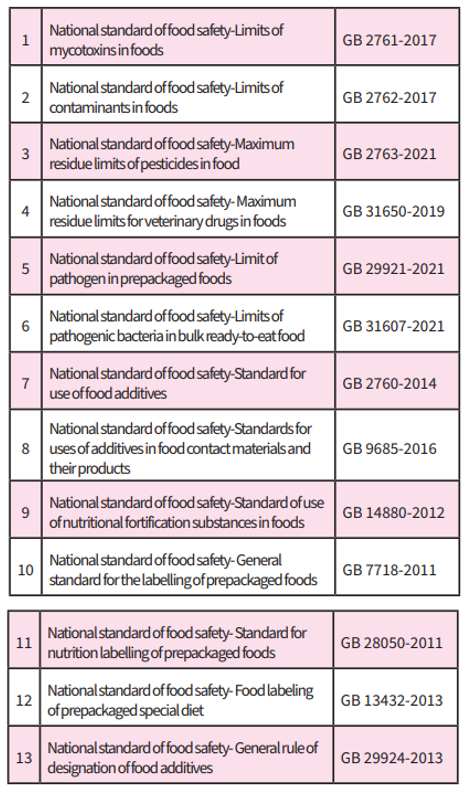
In this way, the national standard problem in food import can be solved. There are 13 common criteria  as the list below:


Among the 13 general standards, the following standards are most commonly used:

✓ General standard for the labelling of prepackaged foods GB 7718-2011 
✓ Standard for nutrition labelling of prepackaged foods GB 28050-2011 
✓ Standard for use of food additives GB 2760-2014 
✓ Limits of contaminants in foods GB 2762-2017 
✓ Limit of pathogen in prepackaged foods GB 29921-2021 

Due to space reasons, the content of the standard will not be explained in detail here. Readers can search about the detailed standard and find the explanation by the professional practitioners of food regulation in accordance with specific situation. 

It is hereby noted that clarified that the use of “most” and other superlatives in this article is to impress the readers and not the absolute words. 


The second category is standard of food products 

A total of 70 national standards are formulated for major food categories (important to people's livelihood), such as various dairy products, rice and flour products, meat products, candy products, seasoning products, etc. 

The third category is special dietary food standards, which is used for specific consumer groups such as infant formula and other special food. Relevant national standards shall be abided by. There are 10 standards in total:


The fourth category is quality specifications and relevant standards of food additives 

This category has the most national standards, 646 in total. All the food additives shall abide by this kind of standard, which will not be listed here due to space reasons. 

The fifth category is quality specification and standard of food nutrition fortifier

There are 53 standards in total. All the food nutrition fortifier shall abide by this kind of standard, which will not be listed here due to space reasons. 

The sixth category is food related product standards 

There are 15 standards in total. Food related products refer to food packaging materials, containers, detergents, disinfectants, etc. and there are 3 important standards: 

detergent GB 14930.1-2015 
disinfectants GB 14930.2-2012 
General safety requirements on food contact materials and articles GB 4806.1-2016 

The seventh category is production and operation specifications and standards 

There are 34 standards in total, which shall be abided by during the production and operation of the food. There are two important standards:

General hygienic standard for food production GB 14881-2013 
Code of hygienic practice in food business process GB 31621-2014 

The remaining standards are various test methods, including 234 physical and chemical test methods, 32 microbiological test methods, 29 toxicological test methods and procedures, 120 pesticide residue test methods and 74 veterinary drug residue test methods.

Conclusion 

The above analysis is based on the announcement of the Food Safety Standards Monitoring and Evaluation Department of National Health Commission in February 2022, which is the latest official announcement. It is hoped that the popularization of science will help nonprofessionals of food regulation to have a preliminary understanding of national standards of food safety. 


Leon Zheng 
                                            HFG Law&Intellectual Property


22/04/2021

Conversatorio "Derecho a la alimentación - Perspectivas internacionales" - 24 de abril de 2021


Desde la Argentina les invitamos a participar del conversatorio "Derecho a la alimentación: perspectivas internacionales", el próximo sábado 24 de abril con importantes referentes que compartirán un intercambio de experiencias a nivel internacional, nacional y de la provincia de Santa Fe sobre la importancia de este derecho en el contexto actual. 

Link de inscripción

--o--


Datos del evento: 

Modalidad: plataforma virtual Google meet. Con inscripción previa para el público a través de formularios de Google. Se brinda certificado de participación. 

Información adicional: victoriabruch@hotmail.com
Fecha: Sábado 24 de abril 10hs (Argentina) - 15hs (España)

Organiza: EnredandoSalud, una iniciativa de Fundación FEIM. www.feim.org.ar 

Para más información sobre FEIM puede visitar nuestras redes sociales:

Para más información sobre EnredandoSalud puede visitar nuestras redes sociales:
https://www.instagram.com/enredandosalud/


28/11/2020

Food shortages, stockpiling and panic buying ahead of Brexit as reported by the British media: a mixed methods content analysis

 Authors: Paul C. Coleman (Honorary Research Fellow), Fatima Dhaif (Academic Clinical Fellow) and Oyinlola Oyebode (Assistant Professor)


ABSTRACT

Background - Government documents warn that if the UK and EU have not negotiated a trade deal by 31 December 2020 the UK could experience increasedfood prices and possible food shortages.

The media have an important role in influencing recipients’ behaviour by promoting reassurance or anxiety on this issue. This study examines how food supply and demand, in the context of Brexit, has been portrayed by the British media.

Methods - A mixed methods content analysis of articles reporting on food supply and demand in the context of Brexit, in three daily newspapers, between 01 January 2015 and 31 January 2020.

Results – Five themes emerged: food shortages and panic buying (appearing in 96% of articles); food supply chain disruption (86%); economic impacts of Brexit (80%); preparation and stockpiling by the government and food sector (63%) and preparation and stockpiling by individuals (22%).

Conclusion - Government messaging reported by the media sought to reassure the public that here will be no food shortages under a no-deal Brexit. These reassurances contradicted warnings from the food sector and leaked government reports of reduced availability of food items.


These 20contradictory messages may have undermined trust in the government, potentially influencing stockpiling behaviour at the individual level.


[This paper is under peer-review].


14/05/2020

OS CONTORNOS DA SEGURANÇA ALIMENTAR NO ÂMBITO DO SISTEMA JURÍDICO MULTILATERAL DE COMÉRCIO

[THE SHAPE OF FOOD SECURITY UNDER THE MULTILATERAL TRADING LEGAL SYSTEM]

Mariagrazia Alabrese.


Resumo:

Apesar do grande esforço da comunidade internacional, a falta de segurança alimentar persiste e piorou nos últimos anos. Entre os múltiplos elementos que podem afetar a segurança alimentar, o comércio na agricultura desempenha um papel significativo em termos positivos e negativos. Considerando a segurança alimentar no sistema multilateral de comércio, uma das questões mais importantes é o próprio conceito de segurança alimentar adotado pelas partes negociadoras. Esse conceito corresponde à definição mais utilizada em nível internacional, ou seja, a definição da FAO? O fórum da Organização Mundial do Comércio apresentou uma noção clara e consistente de segurança alimentar? Este artigo discute o conceito de segurança alimentar proveniente do sistema legal da OMC, examinando as regras do Acordo sobre Agricultura relevante e levando em conta o atual processo de reforma. Palavras-chave: Segurança alimentar; Acordo da OMC sobre Agricultura; regras excepcionais; Direito à alimentação.

Abstract:

Despite great effort by the international community, a lack of food security persists and has even worsened in the last few years. Amongst the multiple elements that can affect food security, trade in agriculture plays a significant role both in positive and negative terms. Considering food security under the multilateral trading system, one of the most important issues is the very concept of food security as adopted by the negotiating parties. Does it match the most commonly used definition at an international level, i.e. the FAO’s definition? Has the World Trade Organization forum come up with a clear and consistent notion of food security? This article discusses the concept of food security emerging from the WTO legal system, examining the rules of the relevant Agreement on Agriculture and taking into account the current reform process. Keywords: Food security; WTO Agreement on Agriculture; Exceptional rules; Right to food.

Vol. 43 (2019) ISSN 0101-7187

26/03/2020

Pensemos en la alimentación futura

Joan Mier Albert             
 Abogado                            
Food Law - Gobernanza alimentaria


La situación de crisis sanitaria que estamos viviendo me hace pensar sobre aspectos que van a cambiar en nuestras prioridades.

En todo el mundo se producen alimentos para 12.000 millones de personas, aunque somos 7.000 millones, de los cuales 1.000 millones padecen hambre crónica, más de 2.000 millones sufren carencias de micronutrientes esenciales y más de 2.000 millones no tienen acceso a agua potable. Por otro lado, un tercio de los alimentos producidos no son consumidos. Este es el panorama, resumido.

Hay una relación estrecha entre alimentación y salud, y sus carencias tienen una repercusión en el desarrollo de la sociedad. Se van a replantear cuestiones relacionadas con:

   - La confianza en la seguridad alimentaria
   - La producción suficiente y sostenible de alimentos
  - Cambios en los hábitos de consumo derivados de una mayor conciencia en el comportamiento individual y colectivo

Por eso creo que se va a generar un mayor interés en reforzar y crear nuevas vías que permitan acumular reservas para la alimentación futura, por ejemplo, a través del incremento de bancos de semillas o el desarrollo de actividades en el ámbito de la bioeconomía.

Estas inquietudes posiblemente tendrán una traducción en un cierto cambio de paradigma de las políticas agroalimentarias, desde la priorización de la seguridad hacia la garantía de una producción suficiente de alimentos.

La política agrícola comunitaria fue uno de los principales pilares del nacimiento de la integración europea y ha sido hasta ahora la política con mayor peso en el presupuesto común europeo y la que ha generado una mayor actividad reglamentaria. En sus sucesivas reformas, la orientación de esta política ha evolucionado desde el objetivo de garantizar un aprovisionamiento alimentario suficiente (food security), hasta el objetivo de asegurar que los alimentos sean seguros (food safety), y, actualmente, conseguir que la producción de alimentos sea sostenible (economía circular).

Los cambios que estamos viendo en el mundo derivados de la constatación de la evolución de magnitudes que nos afectan globalmente, como son la suficiencia energética, el consumo de agua, el cambio climático o la deforestación, nos tiene que hacer pensar sobre si el objetivo prioritario marcado tras el final de la segunda guerra mundial, garantizar la alimentación de la población, no volverá a ser un objetivo no desdeñable en un futuro que ya está llamando a la puerta.

En los últimos diez años Europa ha prestado gran interés a la alternativa energética de destinar tierras de cultivo a la producción de biocombustibles, sin que haya producido grandes resultados positivos y sí algunos negativos, en particular un encarecimiento de las tierras de cultivo. Ciertamente el desarrollo de fuentes de energía alternativas ha propiciado un cierto freno a la evolución de esa dinámica. Otros retos que se plantea Europa son también la disminución de la obesidad, la reducción del desperdicio de alimentos, el consumo eficiente de agua o el desarrollo de nuevas fuentes de alimentación.

Es necesario hacer frente a estos fenómenos para conseguir que la vida de las personas no solo sea más larga sino que se mantenga en buenas condiciones. Se trata de introducir en los hábitos la transición desde una alimentación suficiente a una nutrición adecuada.

Para garantizar que las futuras generaciones tengan acceso a alimentos variados y abundantes es importante que se preste atención a las reservas y el mantenimiento de la biodiversidad. Los bancos de semillas, auténticas “arcas de Noé” alimentarias, van a desarrollar un papel fundamental en ese objetivo. En esos bancos se mantienen preservadas especies vegetales en forma de semillas almacenadas para asegurar su supervivencia. Esto es de vital importancia para la supervivencia de la especie y la salud de los ecosistemas.

Actualmente hay alrededor de 1.500 “arcas de Noé” de variedades vegetales en el mundo. Seguramente la más conocida sea la Svalvard Global Seed Vault. Sus objetivos consisten en conservar la biodiversidad de las especies de plantas y en particular las dedicadas al cultivo, preservar la variedad genética para desarrollar otras variedades (por ejemplo, cultivos resistentes a las plagas), reponer semillas necesarias si se pierden por desastres naturales o provocados, y garantizar el futuro para la agricultura.

Y mientras tanto, el objetivo de sucesivos compromisos políticos globales de reducir la sangrante lacra del hambre en el mundo vemos que queda lejos de ser cumplido.

El propósito de garantizar niveles de seguridad, abastecimiento y sostenibilidad está en la agenda de las políticas alimentarias de Europa y países económicamente más avanzados, mientras el objetivo “hambre cero” en el mundo queda en declaraciones de buenas intenciones de propósitos postpuestos. Hay zonas del mundo en las que todavía falta mucho por hacer. La alimentación de buena parte de la población en muchos lugares de África no alcanza los niveles mínimos requeridos para vivir y desarrollarse. La tradicional explicación justificando esa realidad, basada en las condiciones climáticas y la aridez de buena parte del suelo no pueden ser aceptables en un mundo en el que la investigación permite grandes avances en el desarrollo de proteínas, incluido el cultivo de cereales adaptados a condiciones extremas. Es una cuestión de destinar medios económicos a esa finalidad, y eso requiere voluntad política global.

25 marzo 2020


12/02/2019

Promoting taste helps make insect-based food more appealing


For some people around the world, insects are part of their everyday cuisines. For others, however, the thought of eating insects is unappealing. Advocates who support eating insects say that it offers health and environmental benefits, but a recent study found that this might not be the most effective way to encourage people to eat insect-based food. The results of the study found that promoting the enjoyable features of insect-based food is more effective than emphasizing the health and environmental benefits.


The study subjects were shown an advertisement for an insect-based food product that either highlighted the health and environmental benefits of the food or one that promoted the pleasurable aspects, including taste and claims of quality and luxury, of the food. Then the subjects were given the option to try a chocolate truffle made with mealworm. The results found that the ads promoting the health and environmental benefits were significantly less effective than those that touted the pleasurable aspects at making subjects more willing to try the mealworm chocolate truffle. 


19/04/2017

● Robert Burdock y Peter Ampt, “Food Sovereignty: The Case and the Space for Community Led Agricultural Autonomy within the Global Strategic Framework for Food Security and Nutrition”


Journal of Agricultural Science, Vol. 9 nº 5 (2017) doi:10.5539/jas.v9n5p1.

Publicado como avance on line el 15 de abril de 2017

Abstract

Much has been written about food security, nutrition security and the ability of people to access their food needs. Food sovereignty and the associated ability of people to participate in the production, distribution and consumption decisions of their food have been at the fringe of this discussion. Linked with this is the debate on the question of pursuing policies of food self-sufficiency or policies of self-reliance where food imports are considered a natural extension of food security. Examining the elements of food security through the food system participation framework of food sovereignty is an opportunity worthy of further exploration. This paper seeks to add a dimension to the understanding of food security by considering the value that a food sovereignty perspective has on the right to access food that is nutritious and safe for consumption. Current themes are cited and reviewed, and the implications of both food security and food sovereignty perspectives for the food system are argued. Agricultural trade liberalisation has benefited some societies and harmed others. To this end, the Global Strategic Framework (the Framework) on Food Security and Nutrition has recently incorporated the philosophy of the food sovereignty movement into its guidelines. The Framework provides an opportunity to view food security through a lens of food sovereignty providing guidance for all societies on how to safeguard their food security.

Keywords: food sovereignty, food security, agriculture, political economy