Affichage des articles dont le libellé est Seguridad e inocuidad alimentaria. Afficher tous les articles

20/11/2019

BARCELONA 4.12.2019: Xerrada sobre “El que mai s’ha dit sobre la seguretat alimentària” - Lluis González Vaqué


Dia i hora: Dimecres4 de desembre de 2019 a les 18 hores

Lloc: Sala d'actes de la Demarcació de Barcelona del CETAFC
c/ Enamorats, 62-64 Baixos,  Barcelona (plànol situació)

Informació i confirmació d'assistència (gratuïta):
Sandra Comellas - barcelona@agrifor.org


06/05/2019

How To Avoid Being The Next Food Safety Scandal

Source: Aptean


A recent undercover report did more than uncover low standards of food safety at a major food manufacturer – it also highlighted the importance of organizations having the relevant technology in place to prevent issues arising on the shop floor.
One of the largest food manufacturers recently found itself battling to save its reputation (not to mention its biggest customers), following undercover footage that showed poor food hygiene processes and inadequate scrutiny of its food safety procedures at one of its largest sites.
The scandal revolved around the handling of poultry on the production line, with workers seen altering sell-by dates on packages, as well as mixing old and new produce. The damage was near instantaneous, with three supermarket chains pulling their business and halting deliveries from the factory. Government investigations into the scandal means that the cost to the company’s reputation could grow to catastrophic levels.
At the very least, the organization will suffer with having the terms of its deals to supply the main supermarkets renegotiated aggressively, and in the worst case it could lose the contracts altogether. The scandal could even see members of the leadership team forced out of their positions. They are ultimately responsible for the quality measures and management system put in place. Although they may not be involved in the day-to-day activities, the buck stops with them.
Despite its focus on one organization, the scandal presents a major challenge to all food manufacturers. What has not appeared in the news so far is that this is likely to be the tip of the iceberg. The company involved merely has the unfortunate distinction of being the one exposed. And manufacturers will now be under even greater scrutiny, and challenged to demonstrate their commitment to food safety and consumer welfare.
With such high stakes involved, it can seem strange that companies still rely on in-house (mostly paper-based) procedures on their factory floors. Often the reasons for sticking with the current solution center on attempting to avoid upsetting the status quo. “It’s how we’ve always managed it” is a commonly heard refrain; but, just like the latest software, business practices have to constantly evolve and change to remain relevant and up-to-date with modern manufacturing needs.
The emergence of the digital world has changed the way people across the globe consume information, and the manufacturing world has to evolve and keep pace with this to meet the demands of the big supermarket players. When the importance of data is growing, why should supermarkets not expect their key suppliers to provide quality information to them at the click of a button? And what reason do manufacturers have to not clearly demonstrate that their quality records are trustworthy, authenticated by permissible staff, and show a complete timeline of the quality operations alongside any exceptions and anomalies?
By taking advantage of a solution-specifically designed for the food and beverage industry, businesses can focus on building positive awareness of their brands. 
Another perception that often stands in the way of innovation in manufacturing is that implementing a quality system is a huge investment – both in terms of software and people power. This is simply not the case – and you only need to look at Manufacturing Execution Systems (MES) as an example. They can be implemented and delivering tangible results in under 90 days, which provides manufacturers with the peace of mind that their quality operations are being handled using a built-for-purpose solution.
A solution like an MES gives businesses a clear advantage over their previous paper-based systems. As well as having the ability to show full compliance in the event of an audit, manufacturers can demonstrate that any opportunity for the manipulation and falsification of records has been eradicated. At this point, quality management can be freed up to focus on tasks that actually add value in and around each facility.
Businesses that continue to rely on outdated, paper-based systems risk facing their own scandal and reputation crisis. Even if they avoid this threat, they will be separated from successful companies who select their shop-floor systems more wisely.
These businesses are also in a better position to retain the trust of the world’s biggest supermarkets, safe in the knowledge their quality operations are completely accountable, easily auditable and not open to manipulation or the falsification of records.
What an MES also offers that pen and paper cannot is an operator interface that enables shop floor staff to be alerted when a check is due. This provides site-wide visibility into quality operations, while supporting escalation and alerting routines that ensure the right person knows at the right time whenever a quality issue arises.
Admittedly, it is not the process that is to blame for the systemic mislabeling of food when there appears to be a cultural problem, as indicated by the encouragement of malpractice by supervisors. However, enforcement of good manufacturing practices is made all the more difficult with a paper-based system – opening the door to manipulation and sloppiness. Having an electronic system in place will not make the change alone, but it provides operational transparency and provides management with the visibility it needs to enforce best practice.
The risks to a manufacturer’s reputation of poorly managed quality operations are an issue that companies can actively manage and prevent, purely by implementing the right system to suit their needs. It is a task that should not be approached lightly, but the potential pitfalls are extremely small when compared with the massive impact simply standing still could have on a business wishing to maintain its status quo.
Doing what you have always done is the enemy of progress – whether that means improving the quality of food safety in your factories or driving great results within your business. Implementing a quality system may seem like an undertaking that does not provide a measurable ROI, but when faced with a potentially company-ending scenario – as witnessed recently – that investment in the right system will seem like a small price to pay. At the very least, it could see you avoid being right at the center of the next food safety scandal.

https://www.aptean.com/our-company/news-and-press/manufacturers-avoid-being-the-next-food-safety-scandal

W

10/04/2019

Embracing food-safety advances in a tech-driven world


“A new era of smarter food safety is coming,” said Frank Yiannas, FDA’s deputy commissioner of food policy and response, at the GFSI Conference 2019 in Nice, France. He went on to explain, “a smarter food safety is people-led, FSMA-based and technology-enabled.” Afterwards, Yiannas announced the need for a greater budget for the FDA to invest in modern food safety for 2020 and beyond.
Now the question is, when this new era comes, are you ready?
The food industry is relatively behind on technology compared to other industries, or even within our daily lives. Take a look at the cell phone you have now compared to what you had 10 years ago; it has come a long way with all of its handy and useful features. Why can’t the food industry also benefit from technology? Of course, every coin has two sides, but no one would deny that technology played a significant role in bringing the world closer and making it more efficient nowadays.
The scary part of change is that it’s hard to predict what and when they will come to us, however, they also force us think outside of the box. Instead of debating whether incorporating advanced technology into our daily operations makes sense, why don’t we take a look at our current processes in place and see where technology can truly help us? We now have the opportunity to take advantage of technology to enhance our food safety and quality culture at our own facility. Here are some thoughts to share.

1. Identify what can be automated in your current process with technology

Certain things just can’t be replaced by technology, such as risk assessment or hazard identification (at least for now). However, inventory, temperature checking, testing results recording, or anything executing a command from you or implementing a part of your SOPs can potentially be automated. Execution is also the part where the most error could occur, and technology can help improve accuracy and consistency. Identify those steps systematically and understand what data needs to be captured to help your food safety management system.

2. Work with your technology developer to build technical requirements

Explain to the technology developer exactly how you want the program to operate daily. List the operating steps along with responsibilities step-by-step, and identify what requirements are needed for each step. Translating the paper SOP to a computer program plays an important role in this transition. Not only does it set the foundation for your future daily operation, but it also ensures that the control parameter is not lost during the transition.

3. Keep the integrity of the food safety management system through verification and validation

Once processing steps are done by technology, it doesn’t mean that we no longer have to do anything. We need to verify and validate the technology with certain frequency to ensure the steps are controlled as intended. Confirming that the software or system is capturing the right data at the right time becomes key to ensure the integrity of control risks is not compromised.

4. Utilize “preventative maintenance” on all technology used on site

Just like all equipment, food safety technology needs a preventive maintenance schedule. Check whether it is properly functioning on a certain frequency based on the safety impact in your process flow and take actions proactively.

5. Learn from your own records

The time saved from traditional ways allows us to have more time for looking at control points and records received to identify areas for continuous improvement. There are many ways of studying the data with modeling and trend analysis based on your own facility situation. Either way, those records are your own supporting documents of any changes or modifications to your food safety management system, as well as strong support to your risk assessment for justifications.
Just like Yiannas said, a smarter food safety system is still FSMA based. The goal has never changed; we want to produce sustainable, safe and high-quality products to our consumers, whether we use traditional or advanced approaches. After all, we are utilizing technology as a modern way to help us enhance and simplify our food safety management system; the outcome from the automated technology is still controlled by us.
So when the era comes, we all want to be ready for it.

FST Soap Box

https://foodsafetytech.com/column/changes-in-the-food-safety-industry-face-them-or-ignore-them/

22/01/2019

EU unveils food safety audit priorities for 2019


More than a third of audits and fact-finding missions by the European Commission’s Directorate-General for Health and Food Safety (DG SANTE) will deal with food safety this year.
The EC plans to conduct up to 211 audits and other on-the-spot visits in EU member states and countries outside the region.
Seventy-three, or 34 percent, of audits and fact-finding missions will deal with food safety, 14 percent with animal health and welfare, and 9 percent with plant health. Six percent of audits will look at food quality and feed safety, while 4 percent will concern import controls and follow-up.
The objective is to ensure EU legislation on food safety and quality is properly implemented and enforced.
Outcomes from audits will be available to the public. Findings will be summarized in overview reports as a basis for discussions with member states about identified common challenges and best practices. Results of audit and analysis work supports development of evidence-based policies.
One project ongoing in 2019 is to further reduce the number of human salmonellosis outbreaks in the EU by improving effectiveness of control programs in live poultry. The 2016-2017 outbreak of Salmonella traced to Polish eggs accounted for more than 500 reported cases.

The Commission will look at the correct implementation of Salmonella control programs for poultry populations in member states including audits to Greece and Spain.
A special focus in 2019 will be on countries with important horse meat production or imports and those with a high number of Salmonella outbreaks. Two audits will follow up on the short series on tuna and related foodborne outbreaks.
Belgium, Ireland, Poland and Romania are part of the work on horse meat, France for products from mammals and poultry, Poland and Czech Republic for items from poultry, tuna in Italy and Spain will be looked at as well as fishery products in Cyprus, Denmark and Malta.
Projects on tuna imports from outside the EU and tuna from the EU, ready-to-eat (RTE) food and food improvement agents package will conclude this year. Food additives, enzymes and flavorings are known as food improvement agents.
Belgium and Spain will be subject to audits on RTE food and an overview report will be published to support the Commission’s policy of reducing foodborne outbreaks caused by this category. A pilot fact-finding mission was organized at the end of 2017 and a short audit series took place in 2018.
Audits of official controls for microbiological risks of food of non-animal origin, such as fresh fruit and vegetables eaten raw, and soft berries, including frozen produce and seeds for sprouting are planned for Egypt, Serbia and the United States as well as Hungary, Lithuania and Poland.
For controls of contaminants in food, audits will go to Argentina, Iran and the U.S. and heavy metals will be covered in the work on tuna (Italy and Spain) and fishery products (Cyprus, Denmark and Malta).
Trips to Bulgaria, Greece and Italy and an overview report on food improvement agents are planned this year after a pilot mission in 2017 and four audits in 2018.
Audits are planned to countries outside the EU which requested approval to export various commodities. These cover live bivalve mollusks from South Korea, products from mammals in Australia, Canada, Paraguay and Serbia, items from poultry in Thailand and Ukraine and fishery products from Brazil, Ghana, Mauritania, Namibia, Russia and Tunisia.
In 2017, the Commission did 199 audits and fact-finding missions in food safety and quality, animal health and welfare and plant health, compared to 208 audits, fact-finding missions and study visits in 2016. A total of 77 (39 percent) of audits covered food safety in 2017.
Fact-finding missions included fipronil contamination of eggs and egg products and synergies of official controls with food business operators’ own checks.


09/01/2019

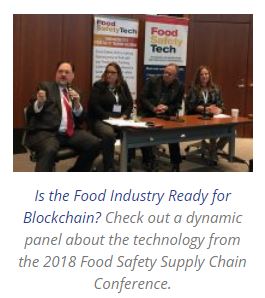
"Food Safety Vs. Blockchain: Who Wins?" [by Maria Fontanazza]


2018 was the year of buzz for blockchain. Questions remain over its potential, benefits and complete adoption by the food industry.

The jury is still out on how (and if) blockchain can contribute to a safer food supply. Whether or not there is a clear understanding of the technology, and its potential and pitfalls, is up for debate as well. “What is blockchain? This is the number one question that people have,” said Darin Detwiler, director, regulatory affairs of food and food industry at Northeastern University, who led a panel of experts as they deliberated over this hot topic during the 2018 Food Safety Consortium.
“Blockchain levels the playing field where we can connect people, resources and organizations in ways we’ve never done before to harness new ways of extracting value,” said Nigel Gopie, global marketing leader, IBM Food Trust at IBM.

What Is Blockchain?

Gopie provided an introductory definition of blockchain: Simply put, it is a series of blocks of information attached together. Each block is a box of information that stores data elements, and this data could be almost anything. Each block has a digital fingerprint associated with it; this fingerprint allows you to know that the block is unique and can attach to other blocks. When new blocks come into the chain, each block has a new fingerprint—one that is unique to that block and of the block before it. This allows the connection to happen, and enables visibility into the origin of each block.
Blockchain enables one book of business and provides three important benefits, said Gopie:
  1. Digital transactions
  2. Distributed ledger with one version of truth throughout the network
  3. Data is immutable
Although blockchain can help to start the process of solving food issues surrounding safety, freshness, reduced waste and sustainability, the technology is only the foundation. A series of other components are important as well, said Gopie, and the following are some insights that the expert panel shared during their discussion.

Can Blockchain Actually Impact Food Safety?

Jorge Hernandez, chief food safety officer at Wholesome International: “To me, it’s a fantastic new technology that would allow the food industry to do a much better job of finding, from seed to fork, all of the processes and things that happen to that product. And in the future, [it] allows us to identify problems first and solve [them]. My problem is it being sold to companies…and not able to deliver on the promise… It bothers me that we are looking at a future that may or may not be there.”
Angela Fernandez, vice president, retail grocery & foodservice at GS1 US: “We’ve been working on traceability and transparency for over a decade—you have to be capturing the data needed, [and] we’re still working on getting it right. We’re just not there yet. I think it’s a great place for us to strive to go towards, but we’re still early in the stages of accepting it as a community.”
David Howard, vice president of corporate strategy at Pavocoin: “Blockchain itself is simply a technology. We’re all here because we’re just trying figure out what application we can use in business. Blockchain is a technology that can help all of you improve operational efficiencies for your bottom line.”

Is Blockchain a Barrier or a Fast Lane to Heightened Liability Concerns?

Shawn Stevens, food industry lawyer and founder of Food Industry Counsel, LLC: “I think the starting point is to ask ourselves what makes food unsafe. It’s a lack of transparency…What blockchain can do is illuminate entire segments of the industry…From a reactive standpoint, blockchain can help us identify a problem [and] solve it. From a preventive standpoint, if I have access to all this information regarding attributes and quality of supplier, I can make better decisions that protect my company.”
“We want to know more and be better informed. Once you know more, you better react and do something. If you’re getting this line of sight and you don’t react to it, that’s what exposes you to liability.”
Darin Detwiler, director, regulatory affairs of food and food industry at Northeastern University: “We need to look at the balance between the reactive use of blockchain and the proactive use.”

What Barriers Does Industry Need to Anticipate?

Fernandez: “The barrier of the standards and interoperability piece—that’s a big question our community is asking us. Scalability… standards are vital…I think that opens up a different discussion when talking about private versus public blockchain.”
Hernandez: “What is my ROI? The issue I have with blockchain is not only the investment in my organization, but I have to bring my entire supply chain with me if I want to get any benefit. There’s a good value proposition, but it requires you to get everyone on board. When you’re a large organization, it’s probably not that hard to do. But a small organization like mine where my suppliers are an Amish community that sells us cheese, that’s a huge mountain to climb. They don’t have the background [or] the technology, and even if they wanted to do it, it’s a big change for them. You’re asking me to make a change in my relationship with my suppliers.”
“Take a look at it from the business continuity [perspective]. What are the changes you’re going to have to make? And that changes that have to be made by everyone who works with you? We should not stay static. We should continue to look for things. If this is the technology that is going to move us forward, let’s start getting prepared.”
From: https://foodsafetytech.com/news_article/food-safety-vs-blockchain-who-wins/

26/07/2016

Barcelona: septiembre de 2016 - Máster oficial de Seguridad Alimentaria


El máster oficial de Seguridad Alimentaria es un máster interuniversitario, coordinado por la Universidad de Barcelona, en el que también participan la Universidad Autónoma de Barcelona y la Universidad Pompeu Fabra. En su organización e impartición colaboran de forma destacada la Agencia Catalana de Seguridad Alimentaria de la Agencia de Salud Pública de Cataluña y el Departamento de Agricultura, Ganadería, Pesca y Alimentación de la Generalitat de Cataluña. La seguridad de los alimentos es una exigencia legal y los problemas que se pueden derivar de la falta de esta pueden tener un impacto muy importante sobre la población. Por ello, el máster responde al interés creciente en la seguridad alimentaria de la sociedad actual y de todos los agentes implicados: consumidores, empresas agroalimentarias y administraciones públicas.


Es un máster de especialización en el ámbito agroalimentario, un sector socioeconómico de amplio espectro que se extiende desde la granja hasta la mesa y se concreta en la preocupación social de los consumidores, individualmente o en asociaciones, para la nutrición humana y la industria alimentaria. En todos los niveles de la cadena alimentaria está presente el interés de la sociedad por la calidad y la seguridad de los alimentos que se le ofrecen. El carácter transversal de la seguridad alimentaria hace que el máster sea complementario a una formación general de cualquier grado relacionado con la alimentación u otras especialidades.

El objetivo del máster es que los estudiantes se especialicen en el ámbito de la seguridad alimentaria. Esta formación puede servir tanto para iniciarse en la investigación científica (estudios de doctorado) como para contribuir a la gestión de la seguridad alimentaria, ya sea en el ámbito de la empresa privada agroalimentaria o en el de la Administración pública, siempre en el marco de un equipo multidisciplinario.