Affichage des articles dont le libellé est Bebidas alcohólicas. Afficher tous les articles

01/06/2022

Switzerland: Prohibited and controlled advertising


Prohibited products and services

What products and services may not be advertised?

Certain products are banned from public advertising altogether, such as prescription drugs. Further, there are several restrictions concerning broadcast advertising: in addition to alcohol and tobacco, advertisements for gambling and lotteries without licence, for political parties and political persons either holding or running for office, and for religious beliefs, are prohibited. Topics that are subject to the popular vote and religious denominations as well as the people and institutions representing them may also not be advertised on the radio or television.

Prohibited advertising methods

Are certain advertising methods prohibited?

Any aggressive methods, such as exercising physical or psychological pressure, cornering prospective clients or in any other way limiting their free decision-making abilities, are prohibited. Spam emails are allowed only if the sender of the advertisement is visibly and correctly recognisable, the message includes a ‘remove me’ or ‘unsubscribe’ option that, when clicked, removes the recipient from the mailing list and if the recipient has given either prior consent to their inclusion in the mailing list or has previously purchased something from the sender. Additionally, mass advertising is restricted, and with the newly adopted article 45a of the Telecommunications Act, telecommunications service providers are now obliged to combat unfair mass advertising. Further, newly adopted provisions of the Federal Act against Unfair Competition (UCA) restrict advertising calls and add a respective opt-in obligation. They also prohibit spoofing in connection with advertising calls. There are a few more specific rules such as, for example, prohibiting the use of loudspeakers on motor vehicles as well as individual cantonal regulations. Furthermore, the guidelines of the Swiss Commission for Fairness ban gender-discriminatory advertising and consider advertising as sexist and, thus, unfair, if it lacks a natural link between the person embodying the gender and the advertised product.

Protection of minors

What are the rules for advertising as regards minors and their protection?

There is no special law concerning the protection of minors in Switzerland: thus, such regulation in the area of advertising falls under the provisions of the UCA. Products unsuitable for minors may not be advertised in media aimed at this target group. Material unsuitable for children must be clearly marked as such. Advertising must not exploit the inexperience and credulity of minors and may especially not display the performance and use of the product in an exaggerated or false manner. It is not appropriate to compromise the social values of minors by, for example, undermining the authority of their parents, displaying violent content or linking the product to social standing. 

The Federal Radio and Television Act stipulates specific rules on advertising to minors in broadcasting, such as the rule that programmes for children may not be interrupted by advertising at all. The advertising of tobacco products directed at minors is prohibited. There are industry codes self-restricting the advertisement of further goods to minors, such as e-cigarettes.

Credit and financial products

Are there special rules for advertising credit or financial products?

In general, the UCA is also applicable to the advertising of credit or financial products. In public advertising of consumer credit, the name of the company of the creditor must be easily and clearly recognisable. The law requires clear indications in the advertisement concerning the net amount of the credit, its total costs and the actual annual interest, as well as at least one example calculation. The Swiss Banking Association advises its members to refrain from any targeted advertising. It further discourages any sort of misleading statements such as ‘savings credit’ and any statements that could encourage uneconomical behaviour.

The advertising of financial instruments is further regulated by financial market regulations (such as the Federal Act on Financial Services or the Federal Banking Act). For example, any advertisement for financial instruments in the sense of financial market law must be readily recognisable as such. Advertisements for financial services (eg, asset management, investments advice) must be marked as such. Non-compliance is punishable with fines of up to 100,000 Swiss francs.

Therapeutic goods and services

Are there special rules for claims made about therapeutic goods and services?

Specific provisions for the advertising of therapeutic goods and services are included in the Federal Ordinance on the Advertising of Medicinal Products, the Federal Ordinance on Medical Devices and the Federal Act on Medicinal Products and Medical Devices. Furthermore, such advertising also falls under the general legal provisions of the UCA.

The applicable law differentiates clearly between advertising targeted at professionals and advertising targeted at the general public. It contains specific provisions and lists regulating what may or may not be advertised or included in such advertising. Advertising directed at the general public for prescription-only medicinal products is prohibited. Advertising for over-the-counter medicinal products to the general public is, in principle, permitted. However, medicinal products which have not (yet) obtained a marketing authorisation in Switzerland may not be advertised.

Food and health

Are there special rules for claims about foodstuffs regarding health and nutrition, and weight control?

Advertising of foodstuffs is regulated by the Federal Act on Foodstuffs and the Ordinance on Foodstuffs and Commodities. Claims concerning the effects or properties of a food that, according to current scientific knowledge, it does not possess, or that are not sufficiently scientifically substantiated are prohibited. Health claims are explicitly prohibited in the advertising of foodstuffs save for a list of authorised nutrition claims. Advertisers may apply for special approval for claims from the Federal Health Ministry. Any nutrition or health claims must be correct and formulated in a way that they are understandable to consumers. Advertisements may not claim possible health hazards in the case of non-consumption of the product and must always include indications on the importance of a varied and balanced diet and a healthy lifestyle. Any health-related claims may not be associated with claims concerning weight loss or the duration and extent thereof.

Alcohol

What are the rules for advertising alcoholic beverages?

Advertisements for alcoholic beverages are, among others, regulated by the Federal Act on Foodstuffs and the Federal Act on Alcohol. As a general rule, advertising for alcoholic beverages must not be directed at children or adolescents and may not include any type of health claims. Additionally, many cantons and municipalities have chosen to issue a general prohibition for public advertising of alcoholic beverages.

The advertising of alcoholic beverages of more than 15 per cent by volume is subject to severe restrictions: for example, advertising is permitted only if its content is directly related to the product; it is prohibited to advertise spirits on the radio or television, on public buildings, on sporting grounds or on public transport.

Tobacco

What are the rules for advertising tobacco products?

Advertising tobacco products is specifically regulated in the Federal Ordinance on Tobacco Products and Products Containing Tobacco Substitutes. It is prohibited to advertise tobacco products on the radio or television and to direct such advertisements towards children and adolescents. All advertisements are subject to a declaration requirement as well an obligation to display warnings.

The organisation ‘Swiss Cigarette’ has established an agreement with the Swiss Commission for Fairness that further specifies and limits tobacco advertising. It particularly states that a general warning must always be in the three official Swiss languages and take up at least 10 per cent of the advertising surface.

In October 2021, the Federal Parliament has passed a revised Tobacco Product Act which will prohibit tobacco advertising on posters, in cinemas, on sports grounds, in and on public buildings and in and on public transport; tobacco advertising aimed at minors; and sponsorship of events for young people or of events of an international character. This Tobacco Product Act constitutes a counter-proposal to the people’s initiative 'Children without Tobacco', which aims at even stricter regulation of the advertisement of tobacco products. Hence, the content and date of coming into force are unknown at present and dependent on the outcome of voting in February 2022.

Against the applicable provisions in the Federal Act on Foodstuffs, based on a recent decision of the Federal Supreme Court, e-cigarettes containing nicotine can now be sold and advertised in Switzerland without particular restrictions as regards the protection of minors if they meet the technical requirements of an EU or EEA member state. However, one of the applicable soft law codes prohibiting sales and advertising to minors has recently been extended to 'other nicotine-containing products' such as e-cigarettes. Under the new Tobacco Products Act, e-cigarettes are intended to be regulated extensively (including their advertising).

Gambling

Are there special rules for advertising gambling?

The offering and advertising of money games are subject to the strict regulation of the Money Games Act. Advertising is allowed only for licensed money games and if it is not misleading or intrusive. In addition, the advertising must not be directed at minors or persons barred from playing money games. The Act further prohibits advertising that implies that the players’ knowledge, skills or other characteristics influence their chances of winning without this actually being the case. There are additional restrictions on the form and time of the advertising. Inadmissible advertising to blocked or underage persons is punishable by a fine of up to 500,000 Swiss francs.

Lotteries

What are the rules for advertising lotteries?

Lotteries are also regulated by the Money Games Act. In general, the running of lotteries must be licensed. As regards the advertising of lotteries, this can be referred to the respective rules applicable to money games. Accordingly, advertising must not be carried out in a misleading or intrusive manner and may not be directed at minors or blocked persons.

Promotional contests

What are the requirements for advertising and offering promotional contests?

The Money Games Act has lifted the previously existing general ban on games of chance for sales promotion. Provided that promotional contests are carried out for a short period only and do not create any danger of excessive gambling, they are exempted from the scope of the Act and the respective rules on licensing and advertising do not apply. Case law will have to show what the terms ‘promotional’, ‘short period’ and ‘danger of excessive gambling’ mean. However, stricter rules apply to media companies: they are permitted to offer and advertise promotional contests only if participation is free and unconditional on purchase.

The UCA requires that all participants in a competition be informed in detail about the conditions of participation and winning. Any ambiguities and misleading information are not permitted in the case of games and promotional contests.

Indirect marketing

Are there any restrictions on indirect marketing, such as commercial sponsorship of programmes and product placement?

Sponsorship in radio and television broadcasts is permitted; however, it must be clearly distinguishable from advertising and the editorial content. Sponsors must be named at the beginning and end of broadcasts and advertising statements may not be included in broadcasts. Companies whose products fall under an advertisement prohibition may usually not act as sponsors. Product placements constitute sponsorship and may not have any advertising effect for the sponsor and towards third parties. Broadcasts with product placements must indicate this at the beginning thereof. Product placement is prohibited in children’s shows.


Other advertising rules

Briefly give details of any other notable special advertising regimes.

Owing to their recognised need to protect their local language, some cantons have special provisions under which advertisements are required to be in a certain language.

Certain professions such as lawyers and doctors are subject to advertising restrictions. In addition, political advertising on the radio and television is banned; however, it is allowed in other media.

According to the Coat of Arms Protection Act, federal, cantonal and communal coats of arms or related symbols and characteristics may not be used in advertising by private persons.


Jones Day -  Armelle Sandrin-Deforge and Karim Tarantino

18/03/2022

Ciara Cullen and Ben Mark (RPC): UK IPO finds gin-uine use of trade mark


The UKIPO has rejected an application by Inver House Distillers for the revocation of a competitor's trade mark. The decision was reached on the basis that genuine use of the mark in question, in the UK, had been successfully demonstrated.

In July 2014, the contested mark, which incorporates the 'Master's logo', a lion device and the sharp shape of the product's bottle, was registered for gin (specifically, London Dry Gin) in class 33, in the EU. Following the expiry of the Brexit transition period on 31 December 2020, a comparable UK trade mark was automatically created by the UKIPO. Inver sought to revoke the UK mark under section 46 of the Trade Marks Act 1994 on the grounds of non-use between July 2014 to 2019 and March 2016 to March 2021 (the Relevant Period).


The UKIPO considered there was a lack of evidence from the trade mark owner, who submitted only 17 invoices and a handful of social media posts and press coverage in support of its case. In particular, the UKIPO noted that the provision of 17 invoices over the course of the Relevant Period was "far from overwhelming," especially when examined through the lens of the UK's thriving gin market. Even so, it concluded that genuine use of the registration had been shown. This was because there was a "consistent and repeated pattern of sales to an exclusive retailer throughout the relevant periods" and because the owner had "attempted to create and maintain a market for their goods under their mark".

The decision will provide comfort to brand owners, in that it demonstrates that use of a trade mark does not have to be substantial to be genuine. Read more 


Source: https://www.rpc.co.uk/perspectives/food-and-drink/rpc-bites-44/#page=1

16/03/2022

INDIA: A matter of ‘PRIDE’


For the reasons explained by the Delhi High Court in the case of Pernod Ricard India Private Limited v. Frost Falcon Distilleries Limited, injunction may be granted against passing off of goods or services despite of an infringement of a registered trademark not having established.

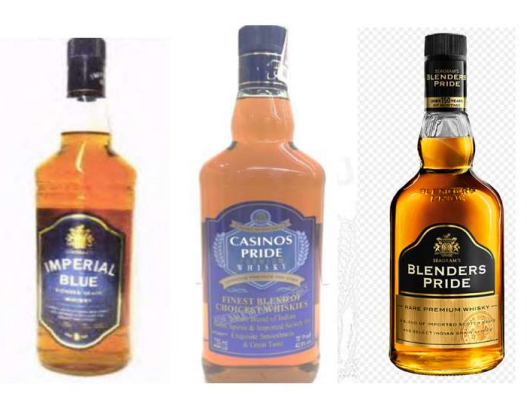
Pernod Ricard India Private Limited (Pernod Ricard) sells alcoholic beverages under the trademarks "BLENDERS PRIDE" and "IMPERIAL BLUE" in India since 1997and 1995 respectively.  FROST FALCON DISTILLERIES LIMITED (Falcon Frost) also sells alcoholic beverages under its own mark "CASINOS PRIDE". Cause of action arose when it came to the knowledge of Pernod Ricard that Falcon Frost had applied for registration for its trademark "CASINOS PRIDE".

Pernod Ricard filed a case in the Delhi High Court, alleging an infringement/passing off of its trademarks, copyrights, and trade dress – an area of trademark law that provides for protection against imitation of specific features including packaging or appearance of the product.

Pernod Ricard contended that the mark "CASINOS PRIDE" was phonetically and deceptively similar with its registered marks "BLENDERS PRIDE" and "IMPERIAL BLUE". Pernod Ricard further claimed that even the overall colour scheme, trade dress, the shape of the bottle and the 3D Mark of "CASINOS PRIDE" were deceptively similar to that of their registered marks.


Source – Judgement

*We do not claim any copyright in the above images. The same have been reproduced for academic purposes.

Against this, Falcon Frost contended that that the expression "PRIDE" is common to the alcoholic beverage trade, and thus Pernod Ricard could not claim exclusivity over the said word.

The Delhi High Court after considering the contentions of the parties, held that Pernod Ricard was not able to make out a case of infringement as the expression/term "PRIDE" is common to the alcoholic beverage trade, and that Pernod Ricard could not claim an exclusivity over the term "PRIDE", instead it could claim its rights over its proprietary marks "BLENDERS PRIDE" and "IMPERIAL BLUE" as a whole, by applying the "Anti-dissection" rule. The anti – dissection rule mandates that the Courts while dealing with cases of trademark infringement involving composite marks, must consider the composite marks in their entirety as a whole rather than dissecting them into its component parts and make comparison with the corresponding parts of a rival mark to determine the likelihood of confusion.

The Delhi High Court observed that although the trademarks were different, in the present matter, all the essential requirements to establish passing off were satisfied. In reaching its conclusions, the Court explained the law on passing off including that, Frost Falcon, had combined distinctive features of different marks so as to suggest an association with Pernod Ricard, which was likely to cause a confusion in the minds of the customers with its label "CASINOS PRIDE‘, the manner in which the mark was being employed and the product was being sold.

Hence, the Delhi High Court granted an interlocutory injunction on an application filed by Pernod Ricard against Falcon Frost. 


14/01/2021

France : le titulaire d’une marque déchu de ses droits peut se prévaloir de l’atteinte portée à ses droits sur la marque qu’ont pu lui causer les actes de contrefaçon intervenus avant sa déchéance


M. B. était titulaire de la marque française semi-figurative « Saint Germain » n° 3 395 502, déposée le 5 décembre 2005 pour désigner, en classes 30, 32 et 33, notamment les boissons alcooliques (à l’exception des bières), cidres, digestifs, vins et spiritueux, extraits ou essences alcooliques. Le 8 juin 2012, M. B. a assigné la société St Dalfour et la société Etablissements Gabriel Boudier (fabricants d’une liqueur de sureau nommée « St-Germain ») et la société Cooper International Spirits (distributeur de cette liqueur) pour contrefaçon de la marque « Saint Germain » n° 3 395 502. Cependant, un arrêt du 11 février 2014, rendu dans une autre affaire, a déchu M. B. de ses droits sur la marque « Saint Germain » à compter du 13 mai 2011. Malgré tout, M. B. a maintenu ses demandes pour la période non couverte par la prescription et antérieure à la déchéance, soit entre le 8 juin 2009 et le 13 mai 2011. Le 13 septembre 2016, la Cour d’appel de Paris a considéré que M. B. ne justifiait d’aucune exploitation de la marque depuis son dépôt. Par conséquent, il ne pouvait arguer d’aucune atteinte au droit de marque. M. B. forma un pourvoi en cassation. Il faisait valoir quele titulaire de la marque peut interdire aux tiers de faire usage, dans la vie des affaires, d’un signe identique ou similaire à sa marque et susceptible de porter atteinte aux fonctions de la marque, sans devoir démontrer un usage sérieux de ladite marque pour ces produits ou ces services.

Les faits ont amené la Cour de cassation a saisir la Cour de justice de l’Union européenne (CJUE) de la question préjudicielle suivante :

« [L’article 5, paragraphe 1, sous b), et les articles 10 et 12 de la directive 2008/95] doivent-ils être interprétés en ce sens que le titulaire, qui n’a jamais exploité sa marque et a été déchu de ses droits sur celle-ci à l’expiration de la période de cinq ans suivant la publication de son enregistrement, peut obtenir l’indemnisation d’un préjudice pour contrefaçon, en invoquant une atteinte portée à la fonction essentielle de sa marque, causée par l’usage par un tiers, antérieurement à la date d’effet de la déchéance, d’un signe similaire à [cette] marque pour désigner des produits ou services identiques ou similaires à ceux pour lesquels [ladite] marque a été enregistrée ? ».

Dans un arrêt du 26 mars 2020, la CJUE a adopté la solution suivante :

« [Les dispositions concernées] laissent aux États membres la faculté de permettre que le titulaire d’une marque déchu de ses droits à l’expiration du délai de cinq ans à compter de son enregistrement pour ne pas avoir fait de cette marque un usage sérieux dans l’État membre concerné pour les produits ou les services pour lesquels elle avait été enregistrée conserve le droit de réclamer l’indemnisation du préjudice subi en raison de l’usage, par un tiers, antérieurement à la date d’effet de la déchéance, d’un signe similaire pour des produits ou des services identiques ou similaires prêtant à confusion avec sa marque » (CJUE, 26 mars 2020, aff. C‑622/18, Cooper International Spirits LLC).

Munie de cette solution, la Cour de cassation a rendu son arrêt le 4 novembre 2020. Elle casse l’arrêt de la cour d’appel de Paris du 13 septembre 2016 et retient la solution suivante :

« la déchéance d’une marque, prononcée en application de l’article L. 714-5 du code de la propriété intellectuelle, ne produisant effet qu’à l’expiration d’une période ininterrompue de cinq ans sans usage sérieux, son titulaire est en droit de se prévaloir de l’atteinte portée à ses droits sur la marque qu’ont pu lui causer les actes de contrefaçon intervenus avant sa déchéance ».

À la suite de quoi l’affaire a été remise devant la Cour d’appel de Paris (autrement composée).


11/01/2021

How food fraud plagued the industry in 2020


It is fair to say that 2020 was a challenging year with wide-ranging effects, including significant effects on our ongoing efforts to ensure food integrity and prevent fraud in the food system. COVID-19 caused major supply chain disruptions for foods and many other consumer products. It also highlighted challenges in effective tracking and standardization of food fraud-related data.

Let’s take a look at some of the notable food fraud occurrences in 2020:

  • Organic Products. The Spanish Guardia Civil investigated an organized crime group that sold pistachios with pesticide residues that were fraudulently labeled as organic, reportedly yielding €6 million in profit. USDA reported fraudulent organic certificates for products including winter squash, leafy greens, collagen peptides powder, blackberries, and avocados. Counterfeit wines with fraudulent DOG, PGI, and organic labels were discovered in Italy.
  • Herbs and Spices. Quite a few reports came out of India and Pakistan about adulteration and fraud in the local spice market. One of the most egregious involved the use of animal dung along with various other substances in the production of fraudulent chili powder, coriander powder, turmeric powder, and garam masala spice mix. Greece issued a notification for a turmeric recall following the detection of lead, chromium, and mercury in a sample of the product. Belgium recalled chili pepper for containing an “unauthorized coloring agent.” Reports of research conducted at Queen’s University Belfast also indicated that 25% of sage samples purchased from e-commerce or independent channels in the U.K. were adulterated with other leafy material.
  • Dairy Products. India and Pakistan have also reported quite a few incidents of fraud in local markets involving dairy products. These have included reports of counterfeit ghee and fraudulent ghee manufactured with animal fats as well as milk adulterated with a variety of fraudulent substances. The Czech Republic issued a report about Edam cheese that contained vegetable fat instead of milk fat.
  • Honey. Greece issued multiple alerts for honey containing sugar syrups and, in one case, caramel colors. Turkey reported a surveillance test that identified foreign sugars in honeycomb.
  • Meat and Fish. This European report concluded that the vulnerability to fraud in animal production networks was particularly high during to the COVID-19 pandemic due to the “most widely spread effects in terms of production, logistics, and demand.” Thousands of pounds of seafood were destroyed in Cambodia because they contained a gelatin-like substance. Fraudulent USDA marks of inspection were discovered on chicken imported to the United States from China. Soy protein far exceeding levels that could be expected from cross contamination were identified in sausage in the Czech Republic. In Colombia, a supplier of food for school children was accused of selling donkey and horse meat as beef. Decades of fraud involving halal beef was recently reported in in Malaysia.
  • Alcoholic Beverages. To date, our system has captured more than 30 separate incidents of fraud involving wine or other alcoholic beverages in 2020. Many of these involved illegally produced products, some of which contained toxic substances such as methanol. There were also multiple reports of counterfeit wines and whisky. Wines were also adulterated with sugar, flavors, colors and water.

We have currently captured about 70% of the number of incidents for 2020 as compared to 2019, although there are always lags in reporting and data capture, so we expect that number to rise over the coming weeks. These numbers do not appear to bear out predictions about the higher risk of food fraud cited by many groups resulting from the effects of COVID-19. This is likely due in part to reduced surveillance and reporting due to the effects of COVID lockdowns on regulatory and auditing programs. However, as noted in a recent article, we should take seriously food fraud reports that occur against this “backdrop of reduced regulatory oversight during the COVID-19 pandemic.” If public reports are just the tip of the iceburg, 2020 numbers that are close to those reported in 2019 may indeed indicate that the iceburg is actually larger.

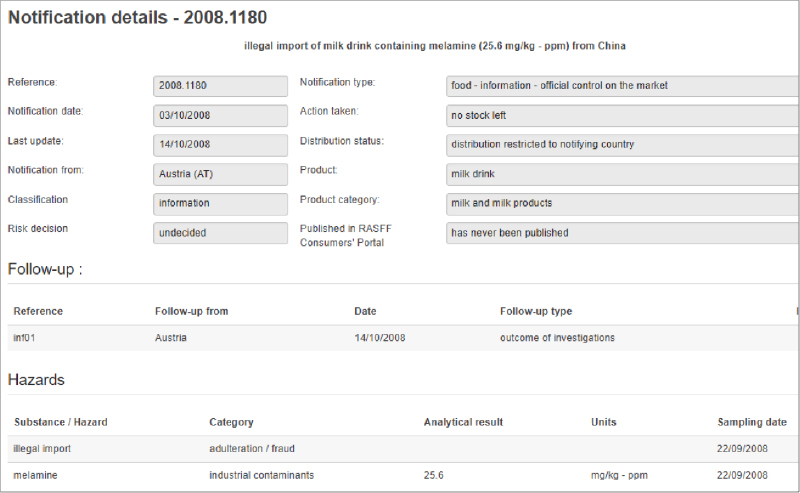
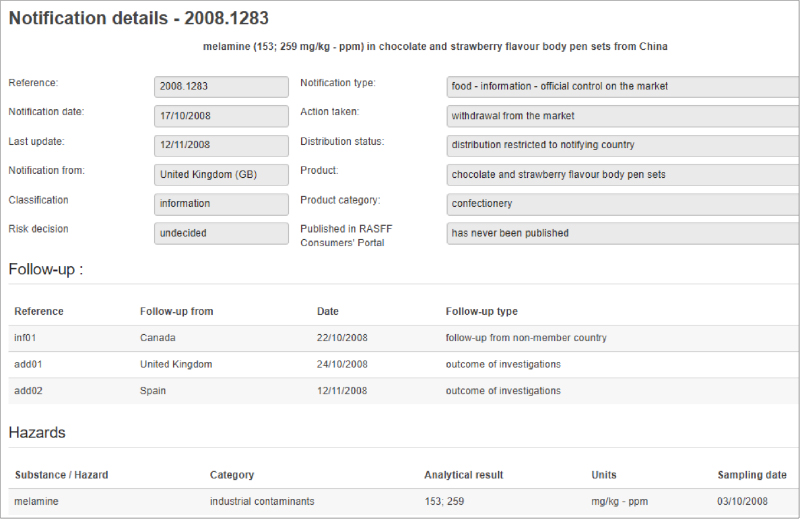
Unfortunately, tracking food fraud reports and inferring trends is a difficult task. There is currently no globally standardized system for collection and reporting information on food fraud occurrences, or even standardized definitions for food fraud and the ways in which it happens. Media reports of fraud are challenging to verify and there can be many media reports related to one individual incident, which complicates tracking (especially by automated systems). Reports from official sources are not without their own challenges. Government agencies have varying priorities for their surveillance and testing programs, and these priorities have a direct effect on the data that is reported. Therefore, increases in reports for a particular commodity do not necessarily indicate a trend, they may just reflect an ongoing regulatory priority a particular country. Official sources are also not standardized with respect to how they report food safety or fraud incidents. Two RASFF notifications in 2008 following the discovery of melamine adulteration in milk illustrate this point (see Figure 1). In the first notification for a “milk drink” product, the hazard category was listed as “adulteration/fraud.” However, in the second notification for “chocolate and strawberry flavor body pen sets,” the hazard category was listed as “industrial contaminants,” even though the analytical result was higher.1

RASFF

RASFF, melamine detection
Figure 1. RASFF notifications for the detection of melamine in two products.1

What does all of this mean for ensuring food authenticity into 2021? We need to continue efforts to align terminology, track food fraud risk data, and ensure transparency and evaluation of the data that is reported. Alignment and standardization of food fraud reporting would go a long way to improving our understanding of how much food fraud occurs and where. Renewed efforts by global authorities to strengthen food authenticity protections are important. Finally, consumers and industry must continue to demand and ensure authenticity in our food supply. While most food fraud may not have immediate health consequences for consumers, reduced controls can lead to systemic problems and have devastating effects.

Reference

  1. Everstine, K., Popping, B., and Gendel, S.M. (2021). Food fraud mitigation: strategic approaches and tools. In R.S. Hellberg, K. Everstine, & S. Sklare (Eds.) Food Fraud – A Global Threat With Public Health and Economic Consequences (pp. 23-44). Elsevier. doi: 10.1016/B978-0-12-817242-1.00015-4

16/04/2020

USA - TTB Publishes Final Rule Modernizing Labeling and Advertising Regulations for Alcoholic Beverages

  • On April 2, 2020, the Alcohol and Tobacco Tax and Trade Bureau (TTB) issued a final rule, which modernizes labeling and advertising regulations for wine, distilled spirits, and malt beverages.  The final rule is effective May 4, 2020.
  • The final rule gives companies flexibility on the placement of mandatory information on distilled spirits labels.  The final rule will allow information, like brand name, class and type of the distilled spirit, alcohol content, and net contents (for containers that do not meet a standard of fill) to appear anywhere on the label, as long as all mandatory information can be viewed simultaneously, without the need to turn the container.
  • The rule also amended regulations that govern specific distilled spirits, like Tequila and Vodka.  For example, the rule created, within the standards of identity, a class called “Agave Spirits,” and two types within that class: “Tequila” and “Mezcal.” Previously, regulations provided a standard for only “Tequila.”  TTB believes that the creation of the ‘‘Agave Spirits’’ class will provide more information to consumers and will allow industry flexibility when labeling products that are distilled from agave.  In regard to Vodka, TTB removed the requirement that vodka be without distinctive character, aroma, taste, or color.
  • TTB’s final rule also affects malt beverages, like beer.  Previously, TTB prohibited “strength claims” on beer labels and in beer advertisements; however, TTB will now authorize such labeling and advertising.  As such, the use of words like “strong,” “full strength,” and “extra strength” will now be allowed.  Per this final rule, TTB will also now allow “other truthful, accurate, and specific factual representations of alcohol content, such as alcohol by weight” to “appear on the label, as long as they appear together with, and as part of, the statement of alcohol content as a percentage of alcohol by volume.”  Thus, brewers will be able to use the same label in states that require alcohol content to be stated as a percentage of alcohol by weight, and in other states that neither require nor prohibit alcohol by weight statements.

W

14/03/2020

Canada: Social Media and Marketing in B.C’s Liquor Industry

In February, 2015 Alcohol & Advocacy summarized the rules and restrictions then in place for advertising and marketing by bars, restaurants and liquor agents.
In December, 2019 the Liquor and Cannabis Regulation Branch published a useful refresher on these principles, with references to law and regulation as well as licensee terms and conditions. Usefully, the six page publication also contains plenty of examples of what is unacceptable (apparently taken from “common non-compliant social media messaging”). The document can be read in full here.
The take away is straight forward: when a liquor licensee, or someone representing a liquor licensee, uses an online platform to promote liquor products they must follow the same rules that apply to traditional forms of advertisement like magazines and radio ads. The ubiquitous and casual nature of social media leads some licensees to believe that “anything goes” on their Facebook or Instagram pages. This is not true. The Liquor and Cannabis Regulation Branch can investigate a licensee’s online presence as a component of a routine compliance check.
Advertisers of alcoholic beverages in BC must do so in accordance with the CRTC’s Code for Broadcast Advertising of Alcoholic Beverages. The Code is designed to ensure that alcoholic beverage advertising does not contribute to the negative health and societal effects related to excessive or inappropriate consumption. The Code can be read in full here, but can also be thought of in terms of five themes, described by the LCRB as follows:
  1. Advertising must not encourage the over-consumption of alcohol;
  2. Advertising must not promote the irresponsible or illegal use of alcohol;
  3. Advertising must not associate alcohol with social or personal achievement;
  4. Advertising must not be directed to persons under the legal drinking age; and
  5. Advertising must not associate alcohol with the use of motor vehicles or with activates requiring a significant degree of skill or care

Examples or what not to do

  • Use an image of a patron handing an open beer to another patron with a caption stating “strangers can become new friends with a beer”
  • Use an image of a group of young people all holding beer bottles, enjoying themselves, with a caption stating “Frosh Week!”
  • Use of an image of Santa Clause (or similar character, real or fictional, considered to be a role model for underage persons) drinking alcohol
  •  Images or content that suggests alcohol is a good way to “get over” a break up or other disappointment in life
  • Sharing social media images of individuals drinking alcohol irresponsibly (e.g. boating without life jackets)
  • Images of individuals drinking alcohol in a public place (e.g. at a beach or in a park)
Many licensees in British Columbia outsource their social media content, or leave it to management to look after from the side of their desk. This lack of diligence can result in unwanted attention by provincial liquor inspectors, and potentially the issuance of a contravention notice. Alcohol & Advocacy recommends that licensees pay the same degree of due care and attention to the content of their online presence as they would with any other advertising initiative: be careful what you say, and be careful what you share.
If your establishment is facing enforcement action by the Liquor & Cannabis Regulation Branch, or you have questions or concerns about advertising and provincial liquor laws, contact Dan Coles at Owen Bird.

*Alcohol & Advocacy publishes articles for information purposes only. They are not a substitute for legal advice, and persons requiring such advice should consult legal counsel.

W