Affichage des articles dont le libellé est Entomofagia. Afficher tous les articles

07/04/2020

How to Promote Food Brands with Influencers


Influencer marketing. You see it all the time – the Instagram models with #ad in their caption, pushing the cute jeans they’re wearing or the blue gummy hair vitamins. If you’re unfamiliar with this trend, you need to crawl out from under your rock, hop on any of the major social media platforms, and take a gander at the advertising age of branded content. It makes sense – YouTube or Instagram influencers have a lot of market power, as they are more relatable than traditional celebrities and have very loyal fan bases. And, most importantly, many reach most brand’s ideal market: the elusive millennial.  

Why Influencers and Content Creators Matter (Even to Bug Companies)

These influencers are, well, quite influential. And it’s not just products they are promoting – it’s a restaurant, an experience, a vacation destination, a way of living, and more. I’m particularly interested in the trend of influencers promoting ideas. Sometimes they start trends, and other times they are the spark that catalyzes a movement into the limelight. Whereas we are accustomed to tuning out traditional advertising, influencer campaigns have not just the “views” or “impressions” required to make an impact, but they also command the genuine attention of their fans.
I read an article on Aeon the other day that put it perfectly: We are “experiencing a fundamental paradigm shift in our relationship to knowledge. From the ‘information age,’ we are moving towards the ‘reputation age’, in which information will have value only if it is already filtered, evaluated and commented upon by others.”
This is why I’m so excited that a few thoughtful content creators have agreed to help spread the word about topics with social impact. Specifically – eating bugs.
Even though Culture Crash is not a “food influencer,” per say, the channel did educate its 157,000 followers about the benefits of eating bugs. And we saw an engaged audience emerge with comments like:
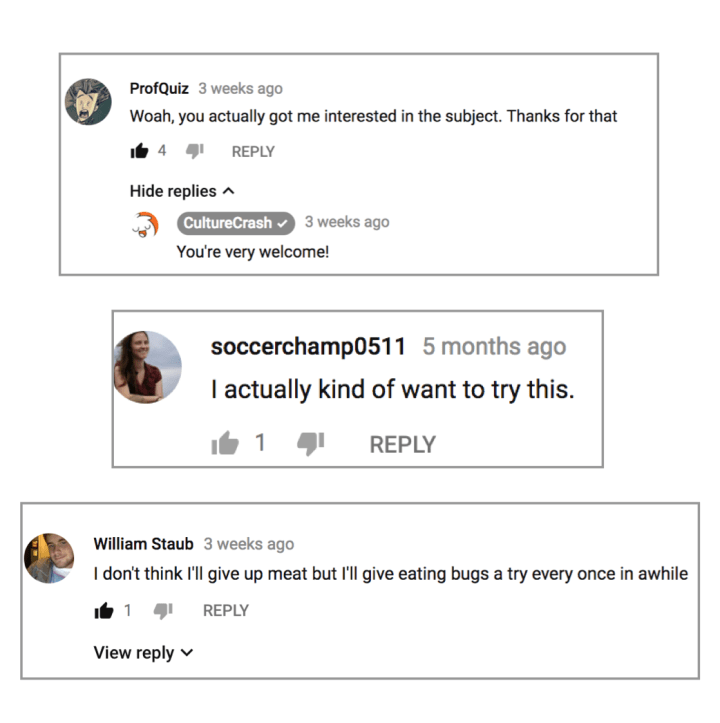
eat-bugs-comments.png

How Influencers Impact Foodie Audiences

Social media has changed the way we eat, shop, travel, and dress. Whether viewers are looking for a new recipe, seeking entertainment by watching a punk metal band eat scorpions, or watching their favorite “muckbang,” food is a thriving topic on platforms like YouTube.
The impact is palpable. According to Millward Brown Digital, food channel subscriptions grew over 280% in 2015 and social engagement on food channels rose by 118%. Most viewers tune into food videos on YouTube for four main reasons: entertainment, exploration, expertise, or relaxation/ease. Videos span the spectrum from inspiration to creation to flat out voyeurism: we watch the chefs, the teachers, and the “watch me eat 3 pizzas in under an hour” daredevils.
The foodie audiences are one of the most highly engaged online – full of people dedicated to all things delicious. These are the folks that are more than happy to devote portions of their paychecks towards food – a passion that translates to huge opportunities for brands. According to a study, 92% of consumers trust recommendations from others, even individuals they don’t know, over heavily branded content.
This is nothing new. Restaurants have long opened their doors to food critics and sites like Yelp are large factors in where we decide to dine out. While these trusted sources are sought out by customers ready to make a purchase decision, working with influencers delivers messages to broader audiences. Also, the content creators lend their creativity and thought leadership to engaging new audiences as well.
One such influencer, Rukshana Kapadia of The Culinary Commentator, explains, “Eating food is an experience. We eat with many senses and the visuals are very important. Instagram has had an enormous impact on the food industry. It’s also been a great tool to entice people to try new cuisines, to become adventurous with their taste buds, to inform people and educate them about the enormous variety of food available…”

Considering Both Macro and Micro Influencers

It’s not just the content creators that have the power of mind-control. 81% of people are influenced by their friends’ social media posts. Let’s admit it – it’s now commonplace to capture and post a beautifully edited photograph of our dinners before we dive in. Reportedly, 74% of consumers identify word-of-mouth (WOM) as a key determinant in their purchasing decision. Forbes suggests 64% of marketing executives believed WOM is still the most effective form of marketing to improve customer engagement and get the word out.
It’s important to note that audiences are highly influenced by the comment sections of the content they are consuming.
Pro tip: make sure you work with influencers that have compassionate and curious communities. It is important to note that the power of influencers does not lie in the follower count. It lies in the tone and engagement of their communities:
eat-bugs-comments-2.png

How to Communicate Through Influencers

As the wise man once said, “It’s not WHAT you say, but HOW you say it.” Audiences might not remember the details of all the content they consume, but they do remember how content makes them feel. I suggest working with influencers to focus on one of three “thematic messages” when crafting content for audiences.
Most food audiences are looking for one of three things: inspiration, education, or curation:
  1. Inspiration: Imagine a mom with a fridge full of leftovers wondering what to do with them. Or a young professional wondering how to make a healthier version of her favorite dish. The new generation turns to content creators to break away from routine, learn about a new cuisine, or find a creative way to serve appetizers at the next “Wine Wednesday.” Brands can create aspirational content to persuade audiences to try new things. 
  2. Education: YouTube and Pinterest are encyclopedias of knowledge for the aspiring chef or twenty-something searching for “How to Boil an Egg.” Brands can work with influencers to teach their audiences how to metaphorically fish – creating new habits or hobbies (aka customers) in the process. Mental Floss is a great example of how an educational community can impact the foodies out there. 
  3. Curation: The social media generation is always looking for trusted sources to help them filter through the myriad of options available to modern consumers. Audiences trust the recommendations of influencers. Find influencers who authentically love your product and provide the proper incentives for them to evangelize. 
Above, you can watch the great cast of Think Tank in a three-part educational video series about trying bugswhy some people eat bugs, and how to normalize bugs.
Consider all types of content, from small, quick videos of cooking and plating techniques to announcements of new restaurant or product launches (or Bugible dinners!)
You can even partner with non-traditional “influencers” like UCLA to create great content.

Feeding Hungry Fans the Right Messages

Don’t get me wrong – I love an Epic Meal Time episode where I can watch big dudes make a 10,000 calorie waffle breakfast with Jack Daniel’s – loaded syrup. But as a past food policy student, I’m here to sing the praises of the influencers that use their powers of persuasion to encourage positive lifestyle changes. The content creators who open up the mind of a picky eater to a new culture’s cuisine. Or the video that shows how small dietary changes can have a huge environmental impact.
Not all content has to be serious to have an impact. We reached Good Mythical Morning’s 13,000,000 followers with videos titled Bug and Wine Pairing Taste Test and Eating A Bug Burrito – Bug War Challenge #2.
Content creators are changing the food industry, and one needs to look out for creators with integrity.  Increasingly, food influencers play a key role in the widespread awareness of culinary trends. We share a deep, personal relationship with food. In the age of social media, it’s not just what we eat that is impacted by our peers, but also when, where, how, and why. Yes, this presents huge opportunities for businesses to impact food-purchasing decisions. More important, perhaps, is the opportunity to impact the dialogue that occurs around how what we eat impacts our bodies and the environment.
According to Bloomberg, $255 million is spent on influencer marketing every month. You don’t need to spend the big bucks to get your message out to the masses. You might even get lucky and land a spot on Netflix’s Bill Nye Saves the World if you persist! 


Derecho alimentario - Online Paper Repository (Food Law)


Acrylamide

Lubna Rifai and Fatima A. Saleh, “A Review on Acrylamide in Food: Occurrence, Toxicity, and Mitigation Strategies”. International Journal of Toxicology (2020) doi.org/10.1177/1091581820902405 [published online before print: 4 February 2020[1]].

Abstract
Acrylamide (AA) is a food contaminant present in a wide range of frequently consumed foods, which makes human exposure to this toxicant unfortunately unavoidable. However, efforts to reduce the formation of AA in food have resulted in some success. This review aims to summarize the occurrence of AA and the potential mitigation strategies of its formation in foods. Formation of AA in foods is mainly linked to Maillard reaction, which is the first feasible route that can be manipulated to reduce AA formation. Furthermore, manipulating processing conditions such as time and temperature of the heating process, and including certain preheating treatments such as soaking and blanching, can further reduce AA formation. Due to the high exposure to AA, recognition of its toxic effect is necessary, especially in developing countries where awareness about AA health risks is still very low. Therefore, this review also focuses on the different toxic effects of AA exposure, including neurotoxicity, genotoxicity, carcinogenicity, reproductive toxicity, hepatotoxicity, and immunotoxicity.


Animal welfare

M. Meylan et al., “Effects of the novel concept ‘outdoor veal calf’ on antimicrobial use, mortality and weight gain in Switzerland”. Preventive Veterinary Medicine (2020) doi.org/10.1016/j.prevetmed.2020.104907 [published online before print: 1 February 2020[2]].

Abstract
The aim of the intervention study ‘outdoor veal calf’ was to evaluate a novel concept for calf fattening which aimed at reducing antimicrobial use without compromising animal health. Management practices such as commingling of calves from multiple birth farms, crowding, and suboptimal barn climate are responsible for high antimicrobial use and mortality in the veal calf population. The risk of selecting bacteria resistant to antimicrobials and of economic losses is accordingly elevated. The ‘outdoor veal calf’ concept, implemented in nineteen intervention farms (IF), is based on three main measures: 1. purchased calves are transported directly from neighboring birth farms to the fattening facility instead of commingling calves in livestock dealer trucks; 2. each calf is vaccinated against pneumonia after arrival and completes a three-week quarantine in an individual hutch; and 3. the calves spend the rest of the fattening period in outdoor hutches in groups not exceeding 10 calves. The covered and bedded paddock and the group hutches provide shelter from cold weather and direct sunshine, constant access to fresh air is warranted. Nineteen conventional calf fattening operations of similar size served as controls (CF). Every farm was visited once a month for a one-year period, and data regarding animal health, treatments, and production parameters were collected. Treatment intensity was assessed by use of the defined daily dose method (TIDDD in days per animal year), and calf mortality and daily weight gain were recorded in both farm groups.
Mean TIDDD was 5.3-fold lower in IF compared to CF (5.9 ± 6.5 vs. 31.5 ± 27.4 days per animal year; p < 0.001). Mortality was 2.1-fold lower in IF than in CF (3.1% ± 2.3 vs. 6.3 % ± 4.9; p = 0.020). Average daily gain did not differ between groups (1.29 ± 0.17 kg/day in IF vs. 1.35 ± 0.16 kg/day in CF; p = 0.244). A drastic reduction in antimicrobial use and mortality was achieved in the novel ‘outdoor veal calf’ system without compromising animal health. The principles of risk reduction used in designing the system can be used to improve management and animal health, decrease the need for antimicrobial treatments and thus selection pressure on bacteria in veal operations.


Entomophagy

Jinsoo Hwang and Ja Young Choe, “How to enhance the image of edible insect restaurants: Focusing on perceived risk theory”. International Journal of Hospitality Management, Vol. 87 (2020) https://doi.org/10.1016/j.ijhm.2020.102464.

Abstract
Although edible insects are getting attention all over the world, consumers are still reluctant to visit edible insect restaurants. Thus, the objective of this research is to explore what risks customers perceive in edible insect restaurants and how those risks affect the image of edible insect restaurants. More specifically, First, the results of principal components analysis showed that 21 perceived risk items were divided into seven factors: quality, psychological, health, financial, environmental, time-loss, and social risks. Second, five sub-dimensions of perceived risk had a negative effect on image, with the exception of financial and environmental risks. Lastly, image was found to increase intention to use, word-of-mouth intention, and willingness to pay more.


Food choices

J. M. Dieterle, “Shifting the Focus: Food Choice, Paternalism, and State Regulation”. Food ethics, Vol. 5 No. 2 (2020) doi.org/10.1007/s41055-019-00059-z [published online before print: 21 December 2019[3]].

Abstract
In this paper, I examine the question of whether there is justification for regulations that place limits on food choices. I begin by discussing Sarah Conly’s recent defense of paternalist limits on food choice. I argue that Conly’s argument is flawed because it assumes a particular conception of health that is not universally shared. I examine this conception of health in some detail, and I argue that we need to shift our focus from individual behaviors and lifestyle to the broader social and environmental context. Such a shift allows us to see the ways in which industry practices are negatively impacting our well-being (a broader concept than “health”). I argue that state regulatory activity surrounding the conditions under which food is grown, processed, marketed, and sold needs to be strengthened. As a result, there are likely to be some indirect limitations on food choice. These indirect limitations are justified, but regulations in which the goal is to change individual behavior or lifestyle are not.


Food Fraud

Joe Whitworth, “Germany - Ex-Bayern-Ei managing director given suspended sentence", IFT (2020) [Blog Source_foodsafetynews/com.2020_03 - available on the Internet at <https://www.foodsafetynews.com/2020/03/ex-bayern-ei-managing-director-given-suspended-sentence/> (last accessed on 22 March 2020)].


Nathaliede Marcellis-Warinac et al., “Food industry perceptions and actions towards food fraud: Insights from a pan-Canadian study”. Food Control (2020) doi.org/10.1016/j.foodcont.2020.107182 [published online before print: 27 February 2020[4]].

Abstract
Food fraud is becoming a major concern for the food industry, consumers and governments. Food industries are accountable for food fraud management and, since January 2018, must implement measures to counter food fraud as part of a Global Food Safety Initiative (GFSI) scheme. However, information related to Food Business Operators' (FBO) perceptions and knowledge on food fraud is still very scarce. Hence, from October 2017 to April 2018, FBOs from different sectors across Canada were invited to answer an online survey of 52 closed-ended questions about their perceptions of food fraud and food fraud management. Close to 400 Canadian FBOs filled out the survey. This paper aims to present their perceptions, concerns and needs relative to food fraud, and their practices to manage and prevent this risk. Answers were collected and analyzed to build a representative picture of the Canadian food industry's perceived readiness and awareness of food fraud. A Kruskal—Wallis test was used to analyze differences among producers, processors and distributors regarding perceptions and knowledge of food fraud. This study provides valuable insights allowing academics and regulators to adapt their communication and collaboration with food industry stakeholders. It could also be used by FBOs as a first base for self-assessment.


Gene editing

Amy te Plate-Church, “Earning public trust in gene editing”. Journal of Animal Science, Vol. 97 Sup. 3 (2019) 57–58.

Abstract
Gene editing has tremendous potential to benefit society and food production. Yet, the social license to develop the technology to its full potential is dependent on public support and market acceptance. Traditionally it has been assumed that sound science and appropriate government oversight will result in social acceptance of innovation. What consumers want first and foremost, according to research from The Center for Food Integrity (CFI), is to know that food producers share their values, like producing safe, affordable, nutritious food in a manner that protects our environment. Sixty-five percent of U.S. consumers surveyed want to know more about how food is produced (CFI, 2017). Testing of videos about CRISPR indicate more than half of viewers want to learn more, and support for CRISPR rose from 45 to 60% when given credible, clear and understandable information. In reviewing more than 15 studies about consumer opinions on biotechnology, CFI found these consistent themes. 1) There is a considerable knowledge gap among consumers – in science and modern plant and animal breeding. 2) Before describing gene editing, it is helpful to show the evolution of genetic improvement. 3) The public wants information from credentialed experts, but they do not want an academic explanation. 4) Analogies and visuals are important to explain science, and they should be understandable without being oversimplified. 5) Consumers show strongest support for benefits of science related to environmental stewardship, healthier food and disease resistance. 6) Consumers have additional questions about use of science in animals, compared to plants. Because scientists and academic institutions among the most-trusted sources for information about biotechnology, they have a unique opportunity to effectively engage and provide information the public wants and needs to make informed decisions about gene editing.


Halal products

Maya F. Farah, “Consumer perception of Halal products: An empirical assessment among Sunni versus Shiite Muslim consumers”. Journal of Islamic Marketing (2020) doi.org/10.1108/JIMA-09-2019-0191 [published online before print: 26 February 2020[5]].

Abstract
Purpose - The purpose of this study is to empirically investigate the effects of religiosity level, ethnocentrism, subjective norms, product judgment and trust in Halal food products on the consumer intention to purchase a Muslim (manufactured in a majority Muslim country) versus a foreign (manufactured in a majority non-Muslim country) product available on the Lebanese market across the two main Muslim sects, namely, Sunnism and Shiism.
Design/methodology/approach - The study used a quantitative survey that was administered to a proportionate stratified sample of 607 respondents from the two sects.
Findings - The results indicate that Sunni consumers indicate a greater trust in judgment of and willingness to buy foreign Halal products compared to their Shiite counterparts, while Shiite consumers display a greater trust in judgment of and willingness to buy Muslim products. Moreover, religiosity, ethnocentrism, subjective norms, brand trust and product judgment have been found to significantly influence consumer purchase intention.
Practical implications - The study results exhibit that religious sect plays a key role in consumer purchase intention, which encourages decision makers and marketers to pursue identity, awareness and communication strategies while targeting Muslim consumers of both sects.
Originality/value - Muslim consumers’ perception of Halal products is a sorely under-researched area of study with minimal empirical data supporting such studies. The results of this study offer some insight into consumer behavior differences between members of the two sects.


Manufacturing transparency

Xinyu Chen and Tobias Voigt, “Implementation of the Manufacturing Execution System in the Food and Beverage Industry”. Journal of Food Engineering (2020) doi.org/10.1016/j.jfoodeng.2020.109932 [published online before print: 25 January 2020[6]].

Abstract
The Manufacturing Execution System (MES) is a production management system serving as the information center in the enterprise to improve manufacturing transparency. It is the middle layer connecting the manufacturing process on the shop floor and the business process on the Enterprise Resource Planning (ERP) level. On the one hand, the MES guides the execution of rough production plans into detailed operations on the shop floor. On the other hand, it provides the firm with critical key performance indicators (KPIs), enabling commercial decisions. The support from the MES, such as production fine planning, performance analysis, and product tracing, can help manufacturers to be efficient and gain more competitiveness in the global market. However, in the food and beverage industry, which faces strict regulations, growing competitiveness, customer demand changing, and suffer from low-profit margins, the implementation of the MES did not become widespread. This article intends to present the particular characteristics of the food and beverage manufacturing process, analyze the potential benefits and barriers of the MES implementation in the food and beverage industry through literature review. The solutions to solve the MES implementation issues and the research areas that need to be explored in order to meet the MES requirements from the food and beverage industry are also discussed in this article.


Meat and meat products

GrahamLawton, “The food revolution starts here”. New Scientist , Vol. 245 No. 3270 (2020) 39-43 [published online before print: 21 February 2020[7]].


Slovenia

Patricia Blatnik and Štefan Bojnec, “Food Quality Schemes: The Case of Slovenia”. Quality - Access to Success, Vol. 21 No. 175 (2020) 131-135.

Abstract
The paper investigates the adoption and diffusion of the European Union food quality schemes focusing on organic food, protected designation of origin, protected geographical indication, and traditional speciality guaranteed products. The country specific focus of results and findings on food quality schemes is on Slovenia, which has potential to increase importance of these possible premium price segment markets with expected higher demands for food quality and safety for health of consumers and benefits to the environment in comparison to conventional food products. The importance of food quality of locally produced products is promoted in activities carried out through several national projects regarding local origin, Slovenian food and countryside with designation of higher food quality. Food quality schemes and protected food products are identified to have economic impacts on supply and demand side of food markets with potential for the producer organizations involved in value chains and the protection of higher quality of locally produced food.


Traceability

Jianping Qian et al., “Food traceability system from governmental, corporate, and consumer perspectives in the European Union and China: A comparative review”. Trends in Food Science & Technology, Vol. 99 (2020) 402-412.

Abstract
Background - Food safety has garnered much worldwide attention recently for reasons that are, unfortunately, not always positive. Traceability system (TS) is designed to assure safe and good quality food, while reducing the costs of food recalls. It should encompass all stakeholders, including governments, companies, and consumers, each of whom has an important role in the implementation and guardianship of such systems. The EU and China are amongst the main players implementing TS and are constantly exploring new opportunities and monitoring challenges for TS in a time of shifting consumer demands and rapid new technology innovation.
Scope and approach - This article states development stages from TS 1.0 to 3.0. and reviews TS development in a number of key countries and regions. Comparisons between the EU and China are drawn in terms of government, corporate, and consumer involvement in traceability.
Key findings and conclusions - A functional TS, while providing bi-directional communication between trading partners, must meet the laws and regulations where it operates. A functional system must also consider consumer value and perception, which varies with geography. There are a variety of promising technologies available on the market today to modernize TS, including artificial intelligence (AI) and blockchain. A key finding of this research is that both the EU and China have developed significant trade links in recent years which will certainly positively impact both economies. Key to underpinning the sustainability of these trade links will be the adoption of common TS to prevent negative associations.


© Luis Gonzalez Vaque 2020

12/02/2019

Promoting taste helps make insect-based food more appealing


For some people around the world, insects are part of their everyday cuisines. For others, however, the thought of eating insects is unappealing. Advocates who support eating insects say that it offers health and environmental benefits, but a recent study found that this might not be the most effective way to encourage people to eat insect-based food. The results of the study found that promoting the enjoyable features of insect-based food is more effective than emphasizing the health and environmental benefits.


The study subjects were shown an advertisement for an insect-based food product that either highlighted the health and environmental benefits of the food or one that promoted the pleasurable aspects, including taste and claims of quality and luxury, of the food. Then the subjects were given the option to try a chocolate truffle made with mealworm. The results found that the ads promoting the health and environmental benefits were significantly less effective than those that touted the pleasurable aspects at making subjects more willing to try the mealworm chocolate truffle.
