Affichage des articles dont le libellé est Marketing. Afficher tous les articles

04/11/2021

🌿 23rd November 2021 - Virtual Event: “The impact of Nutriscore labeling system on the EU”


Information and registration:

l.stella@mustconsulting.com

https://www.farm-europe.eu/contact-us/


Draft Agenda 

14h00 Welcome Speech Yves Madre, President, Farm Europe (France). 

14h05 Opening Remarks 

Francesco Capozzi, Professor, Head of Interdepartmental Centre for Industrial Agrofood Research, University of Bologna (Italy). 

Paloma Quintana Ocaña, Nutritionist and Food Technologist (Spain). 

Luis González Vaqué, Professor, Director of Food and Agrarian Policies of the “Fundació Triptolemos”, (Spain). 

Nicolai Worm, Nutritionist, University of Munich (Germany).


14h35 Round Table 

Ettore Prandini, President, Coldiretti (Italy). 

Sergio Martín Rubio, Director of Technical and Legislation Department, ANICE (Spain).

Luciano Stella, Founder, No-Nutriscore Alliance (Belgium). 

Sebastien Vignette, Secretary-General, Roquefort Confederation (France) – invited. 

Marco Campomenosi, MEP, ID (Italy) – invited.

Paolo De Castro, MEP, S&D (Italy). 

Dolors Montserrat, MEP, EPP (Spain) – invited. 

Adrian Vazquez Lazara, MEP, RE (Spain) – invited. 

Marc Tarabella, MEP, S&D (Belgium) – invited. 


15h50 Conclusions Representative from the European Commission – invited. 


Moderator: Antonella Rossetti, Senior Advisor, Farm Europe.


10/02/2021

Michael K. Goodman and Sylvia Jaworska, “Mapping Digital Foodscapes: Digital Food Influencers and the Grammars of Good Food”


Geoforum (2020) academia.edu/44295367 [published online before print: 30 January 2020[1]].

 Abstract

Drawing on recent debates around food, space and digital media, this paper introduces and develops the concepts of the digital foodscape and ‘good’ food grammars. Through a quantitative and qualitative analysis of the digital platforms, discourses and personas, we investigate the ways a key set of digital food influencers (DFIs) construct, curate and share the meanings of good food. We first explore who these influencers are, describe what platforms they inhabit, how the variable social media affordances work through these platforms and the notions of good food they construct. We then focus specifically on DFIs’ communicative practices on Twitter to analyse the core discourses DFIs produce and those that are taken up by audiences through re-tweets and likes as well as the re-tweeted tweets of DFIs. Overall, our findings suggest that first, good food grammars are being constructed by rule setters beyond the already well-established food personalities and celebrity chefs of the UK’s foodscape. Yet, these grammars also re-inscribe a form of white, hetero-normative middle- and upper- class privilege that produces a particular grammars of good food. Second, different social media and digital platforms provide space for diverse good food grammars given their variable affordances. Twitter, in particular, is the place where the grammars of DFIs take on non-food themes such as self-empowerment, inspiration, charity campaigning and awareness raising. Third, the notions of good food in DFI grammars revolve around a range of constructions, with the most elevated related to ‘clean’ eating and/or ‘clean’ lifestyles that combined healthy, ‘free from’ diets with fitness regimes and expand DFI grammars - and ultimately their brands – into a more holistic lifestyle brand. This paper’s initial empirical and conceptual foray into digital foodscapes and DFIs opens up space for further research on food and digital media within Geography and beyond.


09/10/2020

Ary Rosenbaum: "Marketing is sometimes, just marketing"


The Miller Lite Ads did not inspire to drink beer, but the advertisements were comedy gems from Rodney Dangerfield, Billy Martin, John Madden, Red Auerbach, and a whole host of other sports celebrities (and writer Mickey Spillane for some reason). Less filling, tastes great were the rival chants and Lite Beer from Miller was the first and most successful light beer (until surpassed by Bud Light and Coors Light).

If you drink the beer and you have a sense of taste, you know it’s not very good. It was more marketing that a decent beer recipe. While you may be enticed by the great marketing of a plan provider, you need to dig deeper under the surface to make sure they can do the job. When it comes to marketing, there is nothing wrong to buy on “sizzle”, as long as there is some steak.


13/08/2020

USA - Are Your Claims Too Vanilla? Emerging Litigation Trend Concerning Vanilla Content


A series of cases concerning alleged misrepresentations of vanilla content in products have been filed against retailers and food brands. Notable challenges have largely focused on allegations of misleading representations that a product is flavored only with vanilla beans, when in fact the product is flavored with ingredients other than vanilla.

For instance, Pacific Foods of Oregon, a subsidiary of Campbell Soup Company, is facing allegations of misleading consumers regarding its vanilla hemp milk, in a proposed class action in a New York federal court. Product packaging features a photo of vanilla bean pods, and the flavor is listed as “vanilla.” The lawsuit alleges that consumers are misled in that the product actually contains artificial flavors that imitate vanilla but are not derived from vanilla beans. The lawsuit further alleges that these artificial flavors are disclosed in neither the front label description nor the ingredient list.

Unilever is similarly facing allegations of misleading consumers with respect to the vanilla content of Breyers Natural Vanilla Ice Cream, which is labeled as “Natural Vanilla,” and for which images on product packaging include vanilla beans, vanilla flowers, and ice cream with vanilla bean specks. A California federal judge has denied Unilever’s motion to dismiss in this case, as laboratory testing showed that the flavor is primarily derived from substances other than the vanilla plant.

While these cases are ongoing, a New York federal judge has thrown out claims that Wegmans Food Markets’ vanilla ice cream is falsely labeled, as evidence presented by a proposed class expert was insufficient to prove that there was not vanilla in the products. The judge noted that testing for the presence of specific chemical markers was needed, and further expressed skepticism regarding whether the product labeling was deceptive, as neither the label nor the ingredients list stated that the ice cream uses vanilla bean or vanilla extract.

Why it matters:

According to Truth in Advertising (TINA.org), a nonprofit industry watchdog, there have been nearly 80 class actions to date challenging claims that a variety of foods and beverages are truly vanilla. The cases involve ice cream; plant-based beverages; other types of beverages, including tea, milk, soda, protein drinks and energy drinks; and foods other than ice cream, including cookies, cereals, granola, cake mixes, caramel syrup and yogurts. Marketers should ensure that they have adequate substantiation for vanilla-flavoring claims and that product packaging is not misleading. Stay tuned for updates on this litigation trend.

by Alexa Singh, Jeffrey Edelstein |  Manatt, Phelps & Phillips, LLP

17/06/2020

Are food and drink companies at risk of not protecting their brands?


Food and drink companies invest precious resources in informing and appealing to consumers, making their products the most desirable in a highly competitive and crowded marketplace.
Marketing to the end customer has become even more important to food and drink businesses in the current environment; and businesses are, in the main, now focussing on appealing directly to their customer base.
But - of this investment in building and promoting the brand - how much is spent in ensuring it is properly protected?
Now, more than ever, companies must protect themselves as the food and drink sector sees an influx of change, innovation and new purchasing habits.
How to protect your brand?
The most effective way to protect your brands is to register your trading, and product, names and logos as trade marks.
These registrations will cover the products and services for which the trade marks are used or intended to be used. There are 45 classes of goods and services; so it will be important for the trade mark application to be filed in the correct class (e.g. for beers and breweries registration would need to be in class 32 for beer, class 40 for brewing services and, in some cases, class 25 for clothing and class 43 for pub services).
Why register your brand as a trade mark?
  • Exclusive use – registering a brand as a trade mark gives you the exclusive right to use it in the country where it is registered for the goods and services covered by the registration.
  • Protecting your assets – your brands are amongst your most valuable assets; registering them as trade marks ensures that these assets are properly protected and that their value is secured.
  • Maximising commercial potential – registering your brands as trade marks will enable you to leverage their value through merchandising.
  • Defending your brand – registering your brand for all relevant products will enable you to stop others from exploiting your brand (or similar brands) for these products without your permission
  • Protecting a brand, protects the future – the Bass triangle logo has been registered for over 140 years. So long as you use your trade mark and renew the registration every 10 years, it can be protected for many lifetimes!
What can be done to protect the brand?
  • Brand development – when developing a brand, you need to be sure that this a brand which you can protect and freely use; we can guide you through this process.
  • Registration strategy - we can advise which brands to register, where and for which products and services.
  • Clearance searches - we can check the relevant trade mark registers and advise if there are any existing trade marks which could be an issue for you (e.g. which you may infringe).
  • Trade mark applications – we can attend to applying to register your brand as a trade mark, whether in the UK, the EU or further afield (through our network of international agents).
  • Portfolio management – we can look after your portfolio of registered trade marks, reminding your when these are due for renewal and keeping you up to date with any developments.
  • Exploitation – if you wish to allow others to exploit your brand (e.g. on merchandise), we can advise on how best to do this and protect your brand (and to draft and negotiate any licence agreements).
  • Enforcement – if anyone uses your brand, or a confusingly similar brand, without your permission, we can take action against them to stop this.
Summary
The food and drinks sector can be a cut-throat competitive business, but for companies who get it right, it can also be full of opportunities, with ever-shifting consumer trends providing a chance to diversify and reconnect with customers in a unique way.  The key however for anyone wanting to capitalise on a particular trend, innovation or premium message behind their product is to ensure that they retain control of and protect their brand. 
Also, trade marks are likely to become increasingly innovative in the digital age, just last year the first motion mark was registered by Toshiba and was swiftly followed by other British businesses, including a property developer and dairy food company. It is therefore important to ensure ALL your valuable logos and product names are protected as they develop with your products… and if you don’t, your competitors might…
Contact
Our specialist trade mark team would be very happy to discuss with you how best to protect your brand.  If you would like to explore this further, please contact Nicola Hanglin (nicola.hanglin@mills-reeve.com) or Richard Plaistowe (richard.plaistowe@mills-reeve.com).

08/04/2020

"The Fate of Food Influencers on Instagram" by Deesha Menon


Brad Lau, more commonly known by his handle @ladyironchef, was supposedly the second most popular food influencer on Instagram in 2017, only second to Jamie Oliver. This is both surprising — who would’ve thought a food influencer from a tiny island like Singapore would emerge second in the world? But at the same time also unsurprising — food is what we’re famous for, after all. Singaporeans know how to eat.
Lau has been around for as long as I’ve been on Instagram and probably even before. I remember wondering if he was a woman, because of the word ‘lady’ in his handle. I relied a lot on his articles and reviews to decide where my sister and I should cafe-hop (back when we had the time and expenses to do this), as I am sure a lot of Singaporeans did too. In an era when sponsorship wasn’t too common and people were still using Instagram filters on their images, Lau rose very quickly and admirably to popularity.

But where does ladyironchef stand today?

Popular Chips
This chart shows us that Lau’s audience has actually been steadily decreasing since March 2016. People seem to be less and less interested with Lau’s content, despite the fact that he was one of our food influencing pioneers. I headed to his top performing post in 2018, which is this video of a Korean breakfast toast:

It is interesting to note that his caption does not contain any hashtags, which means he was not paid to post this video. Rather, it seems to be a more organic appreciation of toast.
“This is the best Korean breakfast toast in Seoul. Read more on http://www.ladyironchef.com/2018/07/egg-drop-seoul/“
Ladyironchef is also inimitably known for his blog articles. He’s written a review or listicle on almost every food item/place that he’s been to. Come to think of it, he’s actually doing everything right: videos (1 per day), follow-up articles, simple & readable captions. But the engagement on his images remains low.
Popular Chips
He stands at an average of 0.3% which is much lower than the average engagement rate of 2.7% for accounts in Singapore with more than 500K followers.
I love ladyironchef, but perhaps he is just not what foodies want anymore.

So, who’s taken over?

I had to explore beyond the region to find out who our top food influencers are today. To do so, I ran the hashtags #foodinfluencer and #thediningadvisor through our platform to find posts which also contained the hashtags #ad and/or #spon. Then I narrowed the search to the top 3 accounts that (1) stood out to me, and (2) are handled by people (i.e. not restaurants or agencies). I came up with @glutenfreegalpal, @_federicagenovese, and @jimmyfoodtron.
Let’s take a closer look at each of these accounts.
I began with Genovese, who is an Italian food blogger and food critic. It is interesting that the title ‘food blogger’ should be in English while ‘food critic’ remains in Italian, untranslated. This could possibly point toward the fact that her identity as a food blogger is something she wants recognized internationally — after all, food is a universal language. Genovese’s top performing post of this year is a beautiful picture of cannelloni:

The engagement rate on this post was double her usual engagement rate. A quick scroll of Genovese’s account shows us numerous well-taken pictures of (mostly) Italian food. It’s no wonder 21K people follow this account. The next time you’re looking for a bite in Italy, you know where to find a good recommendation.  
Popular Chips
Genovese’s follower count also has been steadily increasing from end 2017 till now, at incremental rates of 2-7%. While it is natural that 60% of her followers are based in Italy, she also has a sizeable following from the U.S. and U.K.
Next I looked at Jimmy, who has 19.4K followers in total. This food influencer is from Los Angeles which explains why most of his followers are based in America, but this is followed closely by Italy, actually. Italians really love their food too. Jimmy has got an immensely colourful feed. American food is generally carb and cheese heavy, but he manages to make every burger and sandwich look captivating with bright colours and high definition images.
Take a look at his top performing post from this year:

Tell me you don’t want to reach into your phone and grab that.
Jimmy is fairly new to the food influencer game. He grew quickly in the last quarter of 2018, with an average 25% growth rate.
Popular Chips
His growth rate has steadily increased since, though he does seem to suffer from a decreasing engagement rate.
Popular Chips
This was surprising to me because Jimmy plays by all the rules of an ideal Instagram influencer. He has witty captions, eye-catching photos, an adequate number of videos, uses the Instagram Story and highlight function, and enlists giveaways for his followers. I’m not sure why people are disengaging, but either way, here is another scrumptious picture for good measure.

The last food influencer I looked at was Arielle, who goes by the moniker @glutenfreegalpal. As her name suggests, she recommends gluten-free eats for those who are slightly more conscious about their food choices.
Popular Chips
Arielle has 17K followers, and although that is the least of the three, her follower rate increased rapidly in early 2019 as evident from the graph.

Popular Chips
She clearly became a lot more popular this year.
Arielle’s top performing post also outperformed both Genovese and Jimmy. Here it is:

A charming array of vegan birthday-cake cupcakes.

Concluding Thoughts

While these food influencers are doing fairly well for themselves, it seems like people don’t engage with them as much as they do with beauty or health influencers. This might be why influencer marketing hasn’t taken to the food industry as much as beauty, cosmetics, and fashion. Personally I wouldn’t have known this if I didn’t take a look at the metrics — I always assumed there was a market for everyone. Even though all of them abide by the ‘influencer rulebook’ and are forerunners in their industry, they are falling behind other personalities in terms of follower and engagement rate. I am not very much of a foodie myself; I enjoy eating but I avoid spending money on cafes and restaurants, which explains why I don’t follow any food influencers.
Society is definitely changing how they spend their money. Is home-cooking becoming the case? It could very well be.

W

07/04/2020

How to Promote Food Brands with Influencers


Influencer marketing. You see it all the time – the Instagram models with #ad in their caption, pushing the cute jeans they’re wearing or the blue gummy hair vitamins. If you’re unfamiliar with this trend, you need to crawl out from under your rock, hop on any of the major social media platforms, and take a gander at the advertising age of branded content. It makes sense – YouTube or Instagram influencers have a lot of market power, as they are more relatable than traditional celebrities and have very loyal fan bases. And, most importantly, many reach most brand’s ideal market: the elusive millennial.  

Why Influencers and Content Creators Matter (Even to Bug Companies)

These influencers are, well, quite influential. And it’s not just products they are promoting – it’s a restaurant, an experience, a vacation destination, a way of living, and more. I’m particularly interested in the trend of influencers promoting ideas. Sometimes they start trends, and other times they are the spark that catalyzes a movement into the limelight. Whereas we are accustomed to tuning out traditional advertising, influencer campaigns have not just the “views” or “impressions” required to make an impact, but they also command the genuine attention of their fans.
I read an article on Aeon the other day that put it perfectly: We are “experiencing a fundamental paradigm shift in our relationship to knowledge. From the ‘information age,’ we are moving towards the ‘reputation age’, in which information will have value only if it is already filtered, evaluated and commented upon by others.”
This is why I’m so excited that a few thoughtful content creators have agreed to help spread the word about topics with social impact. Specifically – eating bugs.
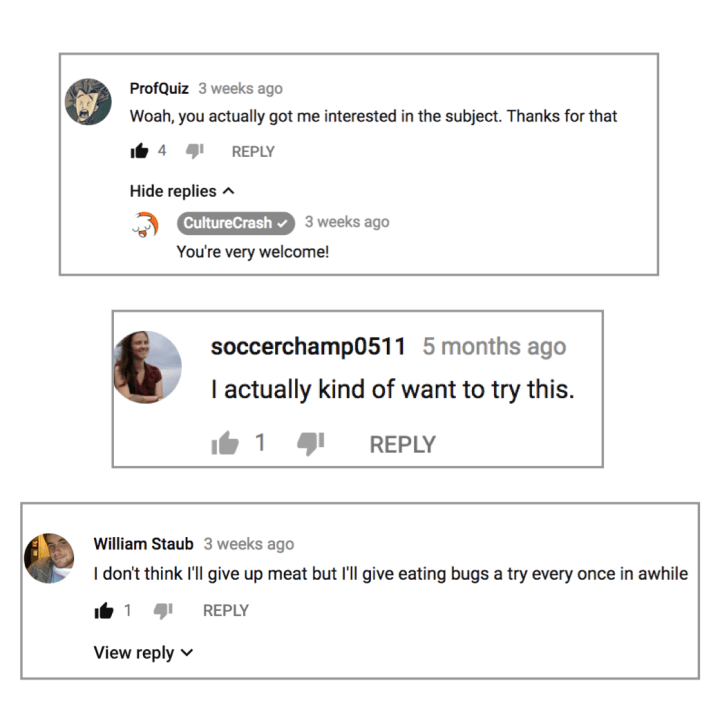
Even though Culture Crash is not a “food influencer,” per say, the channel did educate its 157,000 followers about the benefits of eating bugs. And we saw an engaged audience emerge with comments like:
eat-bugs-comments.png

How Influencers Impact Foodie Audiences

Social media has changed the way we eat, shop, travel, and dress. Whether viewers are looking for a new recipe, seeking entertainment by watching a punk metal band eat scorpions, or watching their favorite “muckbang,” food is a thriving topic on platforms like YouTube.
The impact is palpable. According to Millward Brown Digital, food channel subscriptions grew over 280% in 2015 and social engagement on food channels rose by 118%. Most viewers tune into food videos on YouTube for four main reasons: entertainment, exploration, expertise, or relaxation/ease. Videos span the spectrum from inspiration to creation to flat out voyeurism: we watch the chefs, the teachers, and the “watch me eat 3 pizzas in under an hour” daredevils.
The foodie audiences are one of the most highly engaged online – full of people dedicated to all things delicious. These are the folks that are more than happy to devote portions of their paychecks towards food – a passion that translates to huge opportunities for brands. According to a study, 92% of consumers trust recommendations from others, even individuals they don’t know, over heavily branded content.
This is nothing new. Restaurants have long opened their doors to food critics and sites like Yelp are large factors in where we decide to dine out. While these trusted sources are sought out by customers ready to make a purchase decision, working with influencers delivers messages to broader audiences. Also, the content creators lend their creativity and thought leadership to engaging new audiences as well.
One such influencer, Rukshana Kapadia of The Culinary Commentator, explains, “Eating food is an experience. We eat with many senses and the visuals are very important. Instagram has had an enormous impact on the food industry. It’s also been a great tool to entice people to try new cuisines, to become adventurous with their taste buds, to inform people and educate them about the enormous variety of food available…”

Considering Both Macro and Micro Influencers

It’s not just the content creators that have the power of mind-control. 81% of people are influenced by their friends’ social media posts. Let’s admit it – it’s now commonplace to capture and post a beautifully edited photograph of our dinners before we dive in. Reportedly, 74% of consumers identify word-of-mouth (WOM) as a key determinant in their purchasing decision. Forbes suggests 64% of marketing executives believed WOM is still the most effective form of marketing to improve customer engagement and get the word out.
It’s important to note that audiences are highly influenced by the comment sections of the content they are consuming.
Pro tip: make sure you work with influencers that have compassionate and curious communities. It is important to note that the power of influencers does not lie in the follower count. It lies in the tone and engagement of their communities:
eat-bugs-comments-2.png

How to Communicate Through Influencers

As the wise man once said, “It’s not WHAT you say, but HOW you say it.” Audiences might not remember the details of all the content they consume, but they do remember how content makes them feel. I suggest working with influencers to focus on one of three “thematic messages” when crafting content for audiences.
Most food audiences are looking for one of three things: inspiration, education, or curation:
  1. Inspiration: Imagine a mom with a fridge full of leftovers wondering what to do with them. Or a young professional wondering how to make a healthier version of her favorite dish. The new generation turns to content creators to break away from routine, learn about a new cuisine, or find a creative way to serve appetizers at the next “Wine Wednesday.” Brands can create aspirational content to persuade audiences to try new things. 
  2. Education: YouTube and Pinterest are encyclopedias of knowledge for the aspiring chef or twenty-something searching for “How to Boil an Egg.” Brands can work with influencers to teach their audiences how to metaphorically fish – creating new habits or hobbies (aka customers) in the process. Mental Floss is a great example of how an educational community can impact the foodies out there. 
  3. Curation: The social media generation is always looking for trusted sources to help them filter through the myriad of options available to modern consumers. Audiences trust the recommendations of influencers. Find influencers who authentically love your product and provide the proper incentives for them to evangelize. 
Above, you can watch the great cast of Think Tank in a three-part educational video series about trying bugs, why some people eat bugs, and how to normalize bugs.
Consider all types of content, from small, quick videos of cooking and plating techniques to announcements of new restaurant or product launches (or Bugible dinners!)
You can even partner with non-traditional “influencers” like UCLA to create great content.

Feeding Hungry Fans the Right Messages

Don’t get me wrong – I love an Epic Meal Time episode where I can watch big dudes make a 10,000 calorie waffle breakfast with Jack Daniel’s – loaded syrup. But as a past food policy student, I’m here to sing the praises of the influencers that use their powers of persuasion to encourage positive lifestyle changes. The content creators who open up the mind of a picky eater to a new culture’s cuisine. Or the video that shows how small dietary changes can have a huge environmental impact.
Not all content has to be serious to have an impact. We reached Good Mythical Morning’s 13,000,000 followers with videos titled Bug and Wine Pairing Taste Test and Eating A Bug Burrito – Bug War Challenge #2.
Content creators are changing the food industry, and one needs to look out for creators with integrity.  Increasingly, food influencers play a key role in the widespread awareness of culinary trends. We share a deep, personal relationship with food. In the age of social media, it’s not just what we eat that is impacted by our peers, but also when, where, how, and why. Yes, this presents huge opportunities for businesses to impact food-purchasing decisions. More important, perhaps, is the opportunity to impact the dialogue that occurs around how what we eat impacts our bodies and the environment.
According to Bloomberg, $255 million is spent on influencer marketing every month. You don’t need to spend the big bucks to get your message out to the masses. You might even get lucky and land a spot on Netflix’s Bill Nye Saves the World if you persist!