Affichage des articles dont le libellé est Blockchain. Afficher tous les articles

12/06/2020

Why Blockchain Makes Sense in Supply Chain Management


Some companies are already using blockchain to securely and centrally understand the flow of goods and services. But it also helps multiple parties share information and operate more efficiently.

Written by H. Paris Burstyn
8th June 2020

Key takeaways from this article: 
  • Blockchain enables users to improve quality and customer experience.
  • In IoT supply chains, blockchain can verify product provenance and track assets creating trusted relationships between suppliers and buyers. 
  • Several well-known companies have implemented blockchain in some of their supply chains.

Blockchain isn’t just for currency anymore. This digital ledger technology is a way of managing transactions and doing business. 
Combined with IoT infrastructure, blockchain can support and secure a wide range of supply chain transactions among businesses. 

Blockchain is a secure digital ledger that can track data to generate both trusted and immutable exchanges. IoT connects the networks, monitoring devices and applications to track the locations and conditions of products in the supply chain.

In IoT supply chains, blockchain can verify product provenance and track assets, said Alexandra Rehak, an analyst at Omdia.  It creates trusted relationships between suppliers and buyers by generating encrypted, unchangeable records. 

Rehak noted that blockchain isn’t used to increase revenue, but to enable users to improve quality and customer experience. Manufacturers of “branded goods,” from routers to luxury items, use it to track component parts to prevent gray market items from slipping into the supply chain. This application assures customers get what they pay for.

Several well-known companies have implemented blockchain in some of their supply chains. Most of these started with individual products, but users expect to deploy it across multiple products.

Tracking the Food Supply

In September 2018, Walmart launched its Food Traceability Initiative after a large outbreak of E. coli in romaine lettuce and Salmonella in various products, from eggs to breakfast cereal, rocked the grocery industry.

It gave its fresh leafy green suppliers a year to enable visibility into produce tracking from store back to the farm. Tracing information includes where the greens were grown, when they were harvested, and the supply chain flow before reaching Walmart’s facilities, stores and clubs. Tejas Bhatt, senior director, Global Food Safety Innovation at Walmart said that a majority of Walmart’s leafy green suppliers now use blockchain technology.

Walmart wants to deliver a seamless and transparent food supply chain to engender customer trust. “We believe we can better protect customers from outbreaks by being more proactive than reactive to issues in the supply chain,” said Bhatt in an email interview. “We want to enhance the customer shopping experience by delivering safe, fresh quality foods whether they shop in store or online with Walmart.”

The Internet of Things (IoT) is a cornerstone of tracking freshness by gathering data on the produce’s shipping environment. To monitor shipping conditions for produce, IoT sensors monitor and control the various devices in the fleets of containers hauling the greens. Tracking temperatures and other factors, IoT alerts Walmart and its suppliers if conditions stray from the limits that guarantee freshness and quality.

Early results encouraged Walmart to expand the requirement to its green bell pepper suppliers, which have until July 2020 to adopt the blockchain platform. None of the suppliers has requested an extension despite the COVID-19 pandemic, according to Bhatt. Walmart continues to expand the rollout to deliver fresh, high-quality, and safe foods to customers. 

Walmart’s blockchain launched as a food safety initiative, said Bhatt. But now the company has expanded its efforts to other parts of the business, including merchandising, sourcing, technology and trade. It also conducted pilots with the U.S. Customs and Border Protection Agency on facilitating faster flow of goods across borders. 

Bhatt expects to see incremental benefits as Walmart expands the initiative to other high-risk food items over the next few years. The company aims to get smarter at managing food safety and quality across its supply chains as it compiles more data on blockchain over time 
“For Walmart,” Bhatt said, “the [effort] has matured to a point where it’s no longer a ’blockchain’ initiative. Blockchain is just a tool we’re using to deliver transparency. Our goal is to deliver safe, fresh, quality foods to our customers. Blockchain is enabling us to do that.”

KPMG, IBM, Merck, and Walmart Collaboration With FDA

In February 2019, Walmart announced it would collaborate with KPMG, IBM and Merck to work on the Federal Drug Administration’s (FDA) program supporting the U.S. Drug Supply Chain Security Act (DSCSA) that addresses requirements to identify, track and trace prescription medicines and vaccines distributed within the U.S.

The program developed an electronic, interoperable system that identifies and traces certain prescription drugs as they are distributed within the United States.  According to Asma Ishak-Mahdi, Walmart’s pharmaceutical blockchain lead, the companies formally kicked off the program in May 2019. Between June and November, the team designed, built and tested the solution.

In May 2019 a Deloitte report described survey results from potential and existing blockchain users around the globe. It noted that, on a tactical level, consortia must consider factors that could be difficult to resolve in a group setting including the following:
  • Defining goals 
  • Governance/participation structure
  • Decision making (e.g., equal voting or rotational power)
  • Who owns the solutions intellectual property
In the Walmart consortium, partners defined the scope to test two Merck vaccine products, which were already dispensed at Walmart to track and trace prescription products and create a shared view of product movement, Ishak-Mahdi wrote in an email. “Merck and Walmart, along with IBM and KPMG, designed, developed and tested the technology, working together as partners.”

Each company contributed its individual experiences and expertise to the trial, Ishak-Mahdi said. IBM provided its blockchain knowledge and its currently in-use global platform (Food Trust). KPMG brought its experience in solving DSCSA’s 2019 requirements with the Healthcare Distribution Alliance (HDA). Merck and Walmart defined business requirements and added operational subject matter expertise related to manufacturer and dispenser roles and responsibilities that were incorporated into the pilot design.

The group built a shared permissioned blockchain network that allows real-time monitoring of products. It reduces the time needed to track and trace inventory; allows timely retrieval of reliable distribution information; increases accuracy of data shared among network members; and helps determine the integrity of products in the distribution chain, including whether products are kept at the correct temperature.

The final report included a decision to add scope and participants and was compiled in December 2019 and January 2020, Ishak-Mahdi said. The consortium submitted it to the FDA in February 2020.  It will be posted once the FDA finishes its review of the report.

Source: IoT World Today (6/8) 


28/12/2019

How Blockchain Can Address Food Waste And Hunger


According to the World Food Program (via KPMG), 821 million people -- nearly 1 in 9 on the planet -- go to bed on an empty stomach. At the same time, the UN’s Food and Agriculture Organization reports that around 14% of the world's food is lost before reaching the retail level -- this can happen in on-farm activities, storage and transportation.
So, on one hand we have nearly a billion people who are hungry, and on the other we have mountains of perfectly decent food that gets ruined or discarded. And in the middle of these two poles, we have a simple, easily accessed technology that innovators can use to build a bridge between them. That technology is blockchain.
The End Of Inefficiency
In the industrialized world, food follows a complicated supply chain from harvest, slaughter or catch until it reaches the market and our plates. Food loss occurs anytime that food is discarded, disposed of or ruined as it makes its way along this chain. The key issue at hand is that global food loss does not occur because of deficiency in supply. Many say that the Earth produces more than enough food to feed all of its inhabitants. I believe food loss occurs because of inefficiency.

Much has been written about the endemic inefficiencies and opacity of the global food value chain. And these are not just stumbling blocks to alleviating world hunger. They can also exacerbate agriculture’s unnecessarily high carbon footprint and massive water usage. And they may also increase the frequency of contamination that causes food-borne disease and expensive product recalls.
Despite this, food loss due to inefficiency has garnered relatively little attention. According to one paper, 95% of agricultural research over the past 30 years has been focused on raising productivity, and only 5% has been dedicated to reducing losses.
In an age of increasing transparency in business, government and society, one has to wonder: Why is the food-value chain still so opaque? Why is there so little focus on sustainable food loss mitigation?
As the cofounder of a tech company that's working to address these problems, I believe the answer is more about the interests of the industry than actual capabilities for production.
A Secondary Industry
Chugging just beneath the massive food industry are efforts to reduce the food loss problem. These efforts include the use of fumigation and pesticides. But I believe these efforts are treating the symptoms rather than the disease.
The truth is that the future of a sustainable food ecosystem may depend on how we optimize the supply chain. Rather than continue to skirt the problem of food loss, global food suppliers and tech leaders need to address the systemic inefficiencies at its root. One way they can do this is through blockchain technology.
Using Blockchain To Fight Food Loss
By applying supply-demand algorithms based on consumer behavior and agricultural science to data drawn from advanced sensor technology -- all provenanced by blockchain -- we can predict and preempt the freshness of harvest from field through processing and supply chain stops. Moreover, we can better match supply to demand to avoid the current mismatch between these that leads to food loss.
How would this look? Consider how you could use the blockchain to track a flour producer to verifiably and granularly monitor each shipment of wheat -- when it was harvested, under exactly which conditions it was stored on the farm and during each point in transit, what freshness preservation methods were applied to it, and much more. We can find ways to record each measurement or assessment in the blockchain to result in an inviolate record that's accessible to anyone at any time. That would mean that false storage claims would become significantly harder to create, and hidden freshness manipulations would become significantly easier to discover.
From the demand side, such transparency would mean that our flour producer now has an ironclad assurance of the raw material quality. From the supply side, blockchain-provenanced transparency could quite simply force food suppliers to eliminate inefficiencies in the supply chain. Walmart already plans to use the blockchain to track produce supply chains.
From The Belly To The Bottom Line
Today, I believe we need to extend precision agriculture all the way to the consumer’s plate. It’s not acceptable to leverage advanced technology to minimize yield losses in the field but continue to turn a blind eye to the rest of the food value chain.
This is beginning to happen with an enhanced technology focus on the post-harvest value chain. Companies like AgTrix in Australia and StellaApps in India are taking a bigger-picture approach and leveraging technology to address not just production, but also the business processes that smooth out and track the bumps in the agricultural supply chain.
“Today, each component of an extensive food supply system is being digitalized ... There’s also a big need to increase the labor efficiency of agriculture, the quality of products and supply chain transparency,” noted Dmitry Filatov in an AgFunderNews article. And indeed, digitization is possible. The only thing holding it back -- and that we as tech leaders can work to overcome -- is institutional inertia and antiquated business models.
Calls for increased efficiency in the global food supply chain abound, and more and more technology companies (including SkuChain and Ripe.io) are heeding the call. By leveraging existing technology, we have the ability to bring transparency and accountability to this critical industry -- perhaps alleviating the suffering of a great many hungry people along the way.
Avi Reichental is the Founder of XponentialWorks and chairman & CEO of Nexa3D. Read

15/02/2019

EUIPO to use blockchain in fight against counterfeiting

https://www.limegreenipnews.com/2019/02/euipo-to-use-blockchain-in-fight-against-counterfeiting/#page=1


What has happened?

The European Union Intellectual Property Office (EUIPO) has launched a new forum based on blockchain to combat counterfeiting.

What does this mean?

The Anti-Counterfeiting Blockathon Forum will be built on blockchain technology and will bring together people and organisations to shape and deliver the future anti-counterfeiting infrastructure.
It follows last year’s Blockathon coding competition, which was run by the EUIPO and the European Commission, and is linked to the EU Blockchain Observatory.
The Forum will connect private organisations, enforcement authorities and citizens to support the identification of authentic and counterfeit goods throughout the distribution chain.
It will focus on drafting and defining the anti-counterfeiting use case and related pilot with the ultimate goal of delivering the next level of anti-counterfeiting infrastructure based on blockchain.
The Executive Director of the EUIPO, Christian Archambeau, called on private sector organisations, and all interested individuals to join the anti-counterfeiting forum to help develop and test solutions that would successfully combat the “global plague” of counterfeiting.
“In today’s fast moving world, we need to use the latest technology to keep a reliable record of the origin of goods and their progress through international supply chains. Blockchain’s ability to create permanent and unchangeable records makes it one of the best candidates to deliver results on the ground”, he added.
POSTED BY LIMEGREEN IP NEWS


09/01/2019

"Food Safety Vs. Blockchain: Who Wins?" [by Maria Fontanazza]


2018 was the year of buzz for blockchain. Questions remain over its potential, benefits and complete adoption by the food industry.

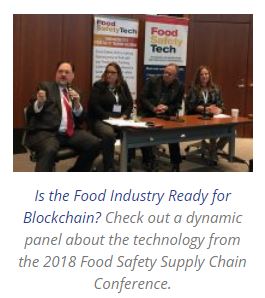
The jury is still out on how (and if) blockchain can contribute to a safer food supply. Whether or not there is a clear understanding of the technology, and its potential and pitfalls, is up for debate as well. “What is blockchain? This is the number one question that people have,” said Darin Detwiler, director, regulatory affairs of food and food industry at Northeastern University, who led a panel of experts as they deliberated over this hot topic during the 2018 Food Safety Consortium.
“Blockchain levels the playing field where we can connect people, resources and organizations in ways we’ve never done before to harness new ways of extracting value,” said Nigel Gopie, global marketing leader, IBM Food Trust at IBM.

What Is Blockchain?

Gopie provided an introductory definition of blockchain: Simply put, it is a series of blocks of information attached together. Each block is a box of information that stores data elements, and this data could be almost anything. Each block has a digital fingerprint associated with it; this fingerprint allows you to know that the block is unique and can attach to other blocks. When new blocks come into the chain, each block has a new fingerprint—one that is unique to that block and of the block before it. This allows the connection to happen, and enables visibility into the origin of each block.
Blockchain enables one book of business and provides three important benefits, said Gopie:
  1. Digital transactions
  2. Distributed ledger with one version of truth throughout the network
  3. Data is immutable
Although blockchain can help to start the process of solving food issues surrounding safety, freshness, reduced waste and sustainability, the technology is only the foundation. A series of other components are important as well, said Gopie, and the following are some insights that the expert panel shared during their discussion.

Can Blockchain Actually Impact Food Safety?

Jorge Hernandez, chief food safety officer at Wholesome International: “To me, it’s a fantastic new technology that would allow the food industry to do a much better job of finding, from seed to fork, all of the processes and things that happen to that product. And in the future, [it] allows us to identify problems first and solve [them]. My problem is it being sold to companies…and not able to deliver on the promise… It bothers me that we are looking at a future that may or may not be there.”
Angela Fernandez, vice president, retail grocery & foodservice at GS1 US: “We’ve been working on traceability and transparency for over a decade—you have to be capturing the data needed, [and] we’re still working on getting it right. We’re just not there yet. I think it’s a great place for us to strive to go towards, but we’re still early in the stages of accepting it as a community.”
David Howard, vice president of corporate strategy at Pavocoin: “Blockchain itself is simply a technology. We’re all here because we’re just trying figure out what application we can use in business. Blockchain is a technology that can help all of you improve operational efficiencies for your bottom line.”

Is Blockchain a Barrier or a Fast Lane to Heightened Liability Concerns?

Shawn Stevens, food industry lawyer and founder of Food Industry Counsel, LLC: “I think the starting point is to ask ourselves what makes food unsafe. It’s a lack of transparency…What blockchain can do is illuminate entire segments of the industry…From a reactive standpoint, blockchain can help us identify a problem [and] solve it. From a preventive standpoint, if I have access to all this information regarding attributes and quality of supplier, I can make better decisions that protect my company.”
“We want to know more and be better informed. Once you know more, you better react and do something. If you’re getting this line of sight and you don’t react to it, that’s what exposes you to liability.”
Darin Detwiler, director, regulatory affairs of food and food industry at Northeastern University: “We need to look at the balance between the reactive use of blockchain and the proactive use.”

What Barriers Does Industry Need to Anticipate?

Fernandez: “The barrier of the standards and interoperability piece—that’s a big question our community is asking us. Scalability… standards are vital…I think that opens up a different discussion when talking about private versus public blockchain.”
Hernandez: “What is my ROI? The issue I have with blockchain is not only the investment in my organization, but I have to bring my entire supply chain with me if I want to get any benefit. There’s a good value proposition, but it requires you to get everyone on board. When you’re a large organization, it’s probably not that hard to do. But a small organization like mine where my suppliers are an Amish community that sells us cheese, that’s a huge mountain to climb. They don’t have the background [or] the technology, and even if they wanted to do it, it’s a big change for them. You’re asking me to make a change in my relationship with my suppliers.”
“Take a look at it from the business continuity [perspective]. What are the changes you’re going to have to make? And that changes that have to be made by everyone who works with you? We should not stay static. We should continue to look for things. If this is the technology that is going to move us forward, let’s start getting prepared.”
From: https://foodsafetytech.com/news_article/food-safety-vs-blockchain-who-wins/