14/01/2021

France : le titulaire d’une marque déchu de ses droits peut se prévaloir de l’atteinte portée à ses droits sur la marque qu’ont pu lui causer les actes de contrefaçon intervenus avant sa déchéance


M. B. était titulaire de la marque française semi-figurative « Saint Germain » n° 3 395 502, déposée le 5 décembre 2005 pour désigner, en classes 30, 32 et 33, notamment les boissons alcooliques (à l’exception des bières), cidres, digestifs, vins et spiritueux, extraits ou essences alcooliques. Le 8 juin 2012, M. B. a assigné la société St Dalfour et la société Etablissements Gabriel Boudier (fabricants d’une liqueur de sureau nommée « St-Germain ») et la société Cooper International Spirits (distributeur de cette liqueur) pour contrefaçon de la marque « Saint Germain » n° 3 395 502. Cependant, un arrêt du 11 février 2014, rendu dans une autre affaire, a déchu M. B. de ses droits sur la marque « Saint Germain » à compter du 13 mai 2011. Malgré tout, M. B. a maintenu ses demandes pour la période non couverte par la prescription et antérieure à la déchéance, soit entre le 8 juin 2009 et le 13 mai 2011. Le 13 septembre 2016, la Cour d’appel de Paris a considéré que M. B. ne justifiait d’aucune exploitation de la marque depuis son dépôt. Par conséquent, il ne pouvait arguer d’aucune atteinte au droit de marque. M. B. forma un pourvoi en cassation. Il faisait valoir quele titulaire de la marque peut interdire aux tiers de faire usage, dans la vie des affaires, d’un signe identique ou similaire à sa marque et susceptible de porter atteinte aux fonctions de la marque, sans devoir démontrer un usage sérieux de ladite marque pour ces produits ou ces services.

Les faits ont amené la Cour de cassation a saisir la Cour de justice de l’Union européenne (CJUE) de la question préjudicielle suivante :

« [L’article 5, paragraphe 1, sous b), et les articles 10 et 12 de la directive 2008/95] doivent-ils être interprétés en ce sens que le titulaire, qui n’a jamais exploité sa marque et a été déchu de ses droits sur celle-ci à l’expiration de la période de cinq ans suivant la publication de son enregistrement, peut obtenir l’indemnisation d’un préjudice pour contrefaçon, en invoquant une atteinte portée à la fonction essentielle de sa marque, causée par l’usage par un tiers, antérieurement à la date d’effet de la déchéance, d’un signe similaire à [cette] marque pour désigner des produits ou services identiques ou similaires à ceux pour lesquels [ladite] marque a été enregistrée ? ».

Dans un arrêt du 26 mars 2020, la CJUE a adopté la solution suivante :

« [Les dispositions concernées] laissent aux États membres la faculté de permettre que le titulaire d’une marque déchu de ses droits à l’expiration du délai de cinq ans à compter de son enregistrement pour ne pas avoir fait de cette marque un usage sérieux dans l’État membre concerné pour les produits ou les services pour lesquels elle avait été enregistrée conserve le droit de réclamer l’indemnisation du préjudice subi en raison de l’usage, par un tiers, antérieurement à la date d’effet de la déchéance, d’un signe similaire pour des produits ou des services identiques ou similaires prêtant à confusion avec sa marque » (CJUE, 26 mars 2020, aff. C‑622/18, Cooper International Spirits LLC).

Munie de cette solution, la Cour de cassation a rendu son arrêt le 4 novembre 2020. Elle casse l’arrêt de la cour d’appel de Paris du 13 septembre 2016 et retient la solution suivante :

« la déchéance d’une marque, prononcée en application de l’article L. 714-5 du code de la propriété intellectuelle, ne produisant effet qu’à l’expiration d’une période ininterrompue de cinq ans sans usage sérieux, son titulaire est en droit de se prévaloir de l’atteinte portée à ses droits sur la marque qu’ont pu lui causer les actes de contrefaçon intervenus avant sa déchéance ».

À la suite de quoi l’affaire a été remise devant la Cour d’appel de Paris (autrement composée).


11/01/2021

How food fraud plagued the industry in 2020


It is fair to say that 2020 was a challenging year with wide-ranging effects, including significant effects on our ongoing efforts to ensure food integrity and prevent fraud in the food system. COVID-19 caused major supply chain disruptions for foods and many other consumer products. It also highlighted challenges in effective tracking and standardization of food fraud-related data.

Let’s take a look at some of the notable food fraud occurrences in 2020:

  • Organic Products. The Spanish Guardia Civil investigated an organized crime group that sold pistachios with pesticide residues that were fraudulently labeled as organic, reportedly yielding €6 million in profit. USDA reported fraudulent organic certificates for products including winter squash, leafy greens, collagen peptides powder, blackberries, and avocados. Counterfeit wines with fraudulent DOG, PGI, and organic labels were discovered in Italy.
  • Herbs and Spices. Quite a few reports came out of India and Pakistan about adulteration and fraud in the local spice market. One of the most egregious involved the use of animal dung along with various other substances in the production of fraudulent chili powder, coriander powder, turmeric powder, and garam masala spice mix. Greece issued a notification for a turmeric recall following the detection of lead, chromium, and mercury in a sample of the product. Belgium recalled chili pepper for containing an “unauthorized coloring agent.” Reports of research conducted at Queen’s University Belfast also indicated that 25% of sage samples purchased from e-commerce or independent channels in the U.K. were adulterated with other leafy material.
  • Dairy Products. India and Pakistan have also reported quite a few incidents of fraud in local markets involving dairy products. These have included reports of counterfeit ghee and fraudulent ghee manufactured with animal fats as well as milk adulterated with a variety of fraudulent substances. The Czech Republic issued a report about Edam cheese that contained vegetable fat instead of milk fat.
  • Honey. Greece issued multiple alerts for honey containing sugar syrups and, in one case, caramel colors. Turkey reported a surveillance test that identified foreign sugars in honeycomb.
  • Meat and Fish. This European report concluded that the vulnerability to fraud in animal production networks was particularly high during to the COVID-19 pandemic due to the “most widely spread effects in terms of production, logistics, and demand.” Thousands of pounds of seafood were destroyed in Cambodia because they contained a gelatin-like substance. Fraudulent USDA marks of inspection were discovered on chicken imported to the United States from China. Soy protein far exceeding levels that could be expected from cross contamination were identified in sausage in the Czech Republic. In Colombia, a supplier of food for school children was accused of selling donkey and horse meat as beef. Decades of fraud involving halal beef was recently reported in in Malaysia.
  • Alcoholic Beverages. To date, our system has captured more than 30 separate incidents of fraud involving wine or other alcoholic beverages in 2020. Many of these involved illegally produced products, some of which contained toxic substances such as methanol. There were also multiple reports of counterfeit wines and whisky. Wines were also adulterated with sugar, flavors, colors and water.

We have currently captured about 70% of the number of incidents for 2020 as compared to 2019, although there are always lags in reporting and data capture, so we expect that number to rise over the coming weeks. These numbers do not appear to bear out predictions about the higher risk of food fraud cited by many groups resulting from the effects of COVID-19. This is likely due in part to reduced surveillance and reporting due to the effects of COVID lockdowns on regulatory and auditing programs. However, as noted in a recent article, we should take seriously food fraud reports that occur against this “backdrop of reduced regulatory oversight during the COVID-19 pandemic.” If public reports are just the tip of the iceburg, 2020 numbers that are close to those reported in 2019 may indeed indicate that the iceburg is actually larger.

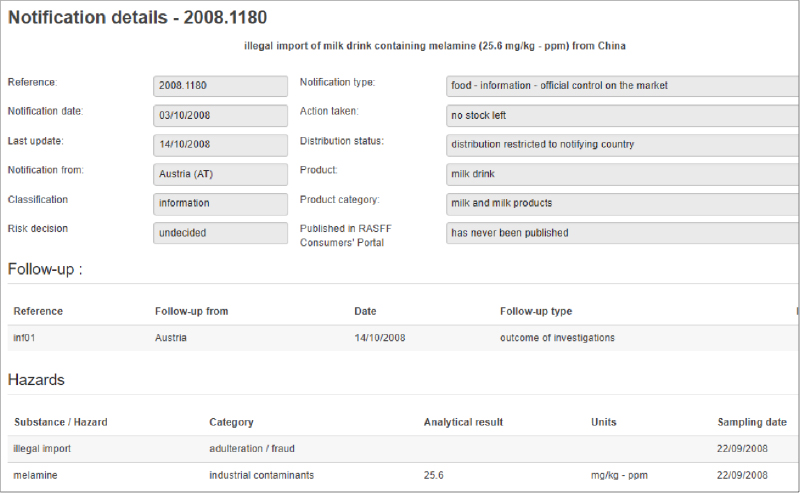
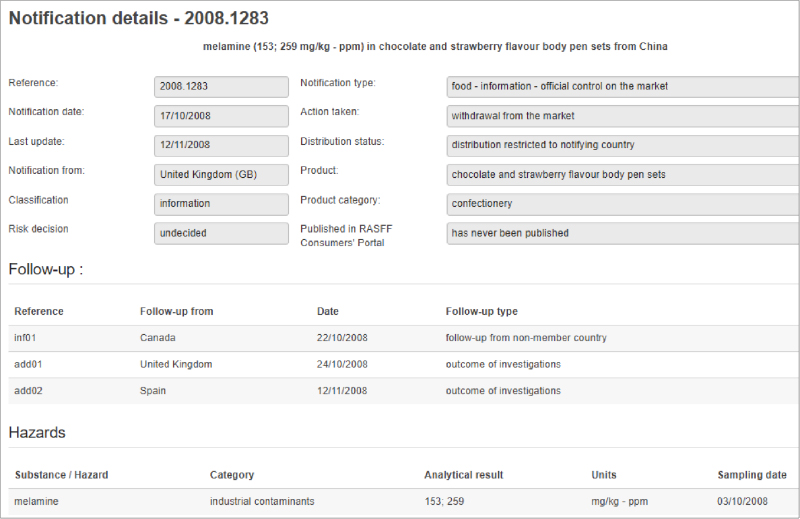
Unfortunately, tracking food fraud reports and inferring trends is a difficult task. There is currently no globally standardized system for collection and reporting information on food fraud occurrences, or even standardized definitions for food fraud and the ways in which it happens. Media reports of fraud are challenging to verify and there can be many media reports related to one individual incident, which complicates tracking (especially by automated systems). Reports from official sources are not without their own challenges. Government agencies have varying priorities for their surveillance and testing programs, and these priorities have a direct effect on the data that is reported. Therefore, increases in reports for a particular commodity do not necessarily indicate a trend, they may just reflect an ongoing regulatory priority a particular country. Official sources are also not standardized with respect to how they report food safety or fraud incidents. Two RASFF notifications in 2008 following the discovery of melamine adulteration in milk illustrate this point (see Figure 1). In the first notification for a “milk drink” product, the hazard category was listed as “adulteration/fraud.” However, in the second notification for “chocolate and strawberry flavor body pen sets,” the hazard category was listed as “industrial contaminants,” even though the analytical result was higher.1

RASFF

RASFF, melamine detection
Figure 1. RASFF notifications for the detection of melamine in two products.1

What does all of this mean for ensuring food authenticity into 2021? We need to continue efforts to align terminology, track food fraud risk data, and ensure transparency and evaluation of the data that is reported. Alignment and standardization of food fraud reporting would go a long way to improving our understanding of how much food fraud occurs and where. Renewed efforts by global authorities to strengthen food authenticity protections are important. Finally, consumers and industry must continue to demand and ensure authenticity in our food supply. While most food fraud may not have immediate health consequences for consumers, reduced controls can lead to systemic problems and have devastating effects.

Reference

  1. Everstine, K., Popping, B., and Gendel, S.M. (2021). Food fraud mitigation: strategic approaches and tools. In R.S. Hellberg, K. Everstine, & S. Sklare (Eds.) Food Fraud – A Global Threat With Public Health and Economic Consequences (pp. 23-44). Elsevier. doi: 10.1016/B978-0-12-817242-1.00015-4

24/12/2020

GEOGRAPHICAL INDICATIONS AND INDIA


INTRODUCTION

Several products that we come across in our everyday lives, like Darjeeling tea, Scotch Whisky, Swiss Gruyere cheese etc. are associated with some geographical region that acts as a source of origin for these goods; thereby authenticating the quality of the goods.

Geographical Indications (GI) is one of the six Trade-Related Intellectual Property Rights (TRIPS) of the World Trade Organization (WTO) that enable comprehensive and effective protection to goods registered as GI goods.[1]


WHAT IS MEANT BY ‘GEOGRAPHICAL INDICATIONS’?

Article 22 of the TRIPS Agreements defines Geographical Indication as "indications which identify a good as originating in the territory of a Member, or a region or locality in that territory, where a given quality, reputation or other characteristic of the good is essentially attributable to its geographical origin".1

In simpler words, a GI tag is a proof of where the product is born or produced. Such a tag acts as a signalling device that helps producers to differentiate their products from competing products in the market on the basis of place of origin and enables them to build reputation and goodwill around their products, as a result of which the goods fetch a premium price.

A comparative analysis between two types of Intellectual Property – trademarks and GIs, shall help understanding the basis of GIs. A trademark is a sign used by an enterprise in order to distinguish its goods and services from those of others and in turn gives its owner the right to exclude others from using the same. Similarly, a geographical indication acts as a source of origin and has certain characteristics that exist due to the geographical location. However, it is pertinent to note that a geographical indication is not an individual property for use only by the owner but instead a public property, and allows every producer in the specified region to use the said GI as long as the superior quality of the GI goods is attributable to the said region.

Apart from acting as a source identifier, a GI performs other functions as well. Some of the said functions are as follows:

i) Provides an indication of quality of the goods: A GI tag symbolises that the specified goods have special qualities as a result of their origin and the said qualities will not be present in other goods of the same category. A GI guarantees that the quality of the goods meets the expectations of the end consumer.

ii) Culture protecting function:A GI protects local culture by preserving traditional productions methods, habits of consumption and cultural identity. 

iv) Boosting the economy as a result of increase in exports: GIs promote economic prosperity by boosting exports as there is a higher demand for goods with GI tags since they let consumers know that the goods come from an area where a given quality, reputation or other characteristic of the goods is essentially attributable to their geographic origin.


GEOGRAPHICAL INDICATIONS AND INDIA

India has a diverse landscape, an extensive rural network and several indigenous goods in the form of handicrafts (Kani Shawl, Bastar Iron Craft) as well as local produce (Nashik Grapes, Mizo Chilly). As a result of being richly endowed with natural and agricultural products, effective protection for GIs was of extreme importance for India.

Thus, in view of the above and in compliance with the TRIPS Agreement of the WTO, 'The Geographical Indications of Goods (Registration and Protection) Act, 1999 (GI Act, 1999) came into force to provide protection to the goods registered under the Act.

The object of the Geographical Indications of Goods (Registration and Protection) Act, 1999, is threefold,

1. By specific law governing the geographical indication of goods in the country which could adequately protect the interest of producers of such goods,

2. To exclude unauthorized persons from misusing geographical indications and to protect consumers from deception and,

3. To promote goods bearing Indian Geographical Indication in the export market.[2]


Further, as per Section 2(1)(e) of the G1 Act, 1999[3], a geographical indication is a sign used on products that have a specific geographical origin and possess qualities or a reputation that are due to that origin. Since the qualities depend on the geographical place of production, there is a clear link between the product and its original place of production.

A striking feature of Indian GIs is the broad variety of product categories which they cater to. The list ranges from agricultural and horticultural products to textiles, handicrafts, paintings and beverages, among other things.

As per Section 11(a) of the GI Act, 1999[4], an application for registration can be made in writing with the Registrar by an association of persons or producers or any organization or authority established by or under any law, provided the same is in the interest of the producers of the concerned goods.

In order to strengthen GI protection, India submitted two proposals at WTO on Intellectual Property Rights issues covering geographical indications. Additionally, India along with Cuba, Egypt, Indonesia and Pakistan also submitted a joint proposal requesting the additional protection given to wines and spirits, to be extended to  other products  as  well. In the Indian context, this shall help export of agricultural and indigenous products like Basmati rice, Darjeeling tea, alphonso mangoes, which are in abundance in India.

As per the available data, India holds more than 85% share of the global ‘Basmati’ exports. Further, the European Union had a share of about 8% in India’s total basmati rice exports during April-May 2020. Thus, European Union is a major market for Indian products and produce specially basmati rice. Recently, the European Commission has also published India’s GI application for ‘Basmati’ rice in the European Union. 

Further, in another recent matter, the mark ‘KASHMIR’, applied for in respect of furniture, has been accepted by the Romanian IP Office (OSIM). Not only is KASHMIR a commonly known place, but also is closely associated and well-known with various handicrafts, including wooden furniture.

 Out of 370 registered GI names on the Indian GI Register, approximately 60% are for handicrafts and in view of the same, one of the issues pertinent for India is the protection of its handicrafts in the European Union, as the European Union has no laws to protect non-agricultural goods under its GI laws.


CONCLUSION

In view of the above, a GI conveys an assurance of quality and distinctiveness, which is an outcome of its place of origin. Further, in today’s globalized world, a GI guards the local culture and tradition from being exploited by outsiders using the GI in order to mislead the customers into believing that the said goods belong to a particular region and thus possess the distinctive quality.

As is mentioned in ‘Embedding Local Places in Global Spaces: Geographical Indications as a Territorial Development Strategy (2010)’, GI status is very unique in the sense that it provides ‘a means of ensuring that control over production and sales of a product stays within a local area, but at the same time [it] makes use of extra local [foreign] markets’.

04/12/2020

"Too many cooks… 'Fit Kitchen' trade mark infringed" By Ben Mark*

UK: The Intellectual Property Enterprise Court issues judgment over use of 
‘Fit Kitchen’ trade mark

Introduction

On 29 July, Fit Kitchen Limited (FKL) won its case for trade mark infringement and passing off against Scratch Meals Limited (SML).

Both FKL and SML provide healthy pre-prepared meals: FKL via an online subscription site, which allows users to customise meal choices, based on their individual macros and dietary preferences and SML, through the manufacture and sale of products to supermarkets.


FKL's products are sold under a stylised logo containing the words 'Fit Kitchen'. The logo has been protected as a UK trade mark since August 2016. Between December 2016 - November 2019, SML also sold products under the sign 'Fit Kitchen'. FKL therefore issued proceedings for trade mark infringement and passing off. SML denied the allegations and counterclaimed, seeking revocation of FKL's trade mark on grounds of bad faith.

Bad faith?

The assertion of bad faith related to the fact that, for a brief time, FKL had been dissolved and removed from the register of companies, for failing to file accounts at Companies House. In 2017, FKL was restored but its trade mark application had been filed during the intervening period (i.e. before its restoration). SML therefore argued that the application had been filed in bad faith and amounted to "an act which fell short of the standards of acceptable commercial behaviour observed by reasonable and experienced men in this area". The Court quickly dismissed this argument for two reasons: firstly, because once restored, a company is deemed to have existed at all times; and secondly, because the second claimant (who was the co-founder of FKL) was unaware that the company had been struck off and had continued to trade, under the FKL banner, throughout.

When considering FKL's infringement claim, the Court found that this failed under s10(3) of the Trade Marks Act 1994 (TMA) (detriment and/or taking unfair advantage of the repute of a trade mark), on the basis that FKL's trade mark did not have the requisite reputation at the relevant time. FKL's claim under 10(2) TMA (likelihood of confusion) was however successful, in some part due to considerable evidence of actual confusion between the parties' products (65 instances, in total, were presented to the Court). Despite lacking the necessary reputation to succeed under s10(3) TMA, FKL's claim for passing off was also successful.

Key takeaways

FKL is a relatively small business with a modest turnover, As the considerably larger entity, both in terms of revenue and operations, SML may have hoped to negate a likelihood of confusion and that the Court would find that FKL had not built up enough reputation and goodwill in its 'Fit Kitchen' brand to succeed with its claims under s10(3) TMA and in passing off. The case however serves as an important reminder that the threshold for establishing goodwill in passing off claims is lower than the threshold for establishing reputation under s10(3) TMA. It also reiterates that whilst evidence of actual confusion is not necessary to succeed in a claim under s10(2) TMA, it goes a long way.


* Ben Mark is a Partner in IP & Technology at RPC in London. Ben can be contacted at ben.mark@rpc.co.uk.


01/12/2020

Nathalie Codignola: "Evolution de la pratique Suisse concernant la protection des indications de provenance protégées"


« Contrairement aux marques, les indications de provenance n'attribuent pas les produits qui en portent la marque à une entreprise spécifique, mais à un pays, une région ou une localité. Les indications de provenance doivent donc être protégées contre les signes susceptibles de faire naître des idées fausses sur l'origine des produits ».

L’Institut Fédéral de la Propriété Intellectuelle (IPI) prévoit dans ses Directives en matière de marques (Directives) des cas dans les lesquels des indications de provenance peuvent être considérées comme suffisamment distinctives pour échapper au domaine public, à l’exclusion totale des indications géographiques faisant l’objet d’une protection par le droit international ou une législation spéciale. Pour de tels signes, la demande d’enregistrement de marque était systématiquement refusée sur la base de l’appartenance au domaine public et de l’atteinte au droit en vigueur.

A ce titre, la marque de jeux et jouets « Ravensburger » en classe 28 avait été refusée en Suisse notamment au motif qu’elle pouvait être confondue avec l’indication « Ravensburger Spiele », protégée par un traité bilatéral entre la Suisse et l’Allemagne, alors que l’Allemagne elle-même l’avait acceptée à l’enregistrement.

Il est bien connu que la Suisse se montre en général plus sévère que peut l’être la majorité des autres pays lors de l’examen d’indications de provenance, et que l’IPI fait rigoureusement application de critères d’examens qui lui sont propres. Néanmoins, quelques signes d’assouplissement semblent commencer à émerger de la pratique.

Tout d’abord, une évolution visible entre les deux dernières versions des Directives concerne les indications protégées par les ADPIC, auxquelles le caractère distinctif peut désormais être reconnu quand elles ne sont pas connues du public suisse, et que leur réservation n’entrave pas le besoin de disponibilité.

Depuis le 1er août 2020, un nouveau changement de pratique fait écho à cette évolution puisque dorénavant l’IPI accorde une certaine marge de tolérance en ce qui concerne les indications de provenance protégées : les signes composés de telles indications sont ainsi susceptibles de bénéficier d’une protection par le droit des marques si, de manière cumulative, ils remplissent les conditions suivantes :

  1. le risque de tromperie est écarté par la limitation des produits et services à la provenance géographique,
  2. le nom géographique concerné est enregistré comme marque verbale dans le pays d'origine,
  3. le nom géographique n’est pas connu du public suisse.

La deuxième condition attire particulièrement notre attention en ce qu’elle témoigne de la volonté de l’IPI de ne pas se montrer plus sévère que l’Office des marques du pays d’origine, alors qu’il ne tient quasiment jamais compte des marques protégées à l’étranger - y compris dans leur pays d’origine - dans le cadre de son examen.

Il n’en demeure pas moins que cette opportunité reste très spécifique et par conséquent ne bénéficierait qu'à de rares cas dans lesquels, par exemple, une indication est protégée par un vieil Accord et qu'on remarque, d’une part, qu'il n'y a plus de protection géographique actuellement, et d’autre part, que le pays d'origine avait enregistré cette indication en faveur d'une entreprise bien particulière. Dans tous les autres cas, on comprend très bien que indications protégées ne puissent pas être enregistrées comme marques.


Source: Novagraaf 26.10.2020


Definición legal y supuestos controvertidos de la condición de consumidor - Análisis comparado de los Derechos español y argentino

 María Constanza Garzino - TESIS DOCTORAL (2020) 395 págs.

https://www.linkedin.com/feed/update/urn:li:activity:6739586002991546368

Resumen 

En esta tesis se estudia la diversidad de criterios existentes para identificar al consumidor, tanto en el derecho español como en el argentino. Se analizaron los antecedentes, características, fundamentos, principios, fuentes y presupuestos del derecho del consumidor, como también la definición legal de este sujeto, las opiniones doctrinales y jurisprudenciales. La identificación de tendencias, sus fortalezas y debilidades, permite tomar postura al respecto. Se examinaron las clasificaciones del consumidor, los supuestos controvertidos respecto a la categoría que resultan comunes en ambos países y los ámbitos específicos en los que puede existir un consumidor. La ejemplificación elegida nos muestra resultados que avalan la necesidad de proponer criterios fundados superadores de las divergencias existentes. Se concluye que, si bien en el derecho español existe mayor certeza que en el argentino respecto a los supuestos debatidos, sería conveniente que en ambos se adopte legislativamente una decisión concreta y a tal fin se asumieron y argumentaron posturas para cada caso. 


30/11/2020

INDIA: "Bull with or without bull" by Dr Mohan Dewan [RK Dewan & Co]


Red Bull AG (Red Bull) filed(*) an application for removal of the word mark YOUR WINGS TO LIFE2 registered in the name of Dr. Reddy's Laboratories Limited (Dr. Reddy’s) before the Intellectual Property Appellate Board (IPAB). Dr. Reddy’s did not appear for the hearing and also failed to file a counter statement. 

Red Bull claimed that it adopted the mark GIVES YOU WINGS in conjunction with its Red Bull trademarks and used it in its promotional and advertising material as well. Red Bull claimed that it has multiple registrations for the mark GIVES YOU WINGS in Class 32. 

Red Bull also claimed that it has adopted the device of wings in its commercials. The concept of an animal/human acquiring wings after consumption of the Red Bull Energy Drink has become exclusively associated with Red Bull. It also claimed that it is the registered owner of the domain name www.givesyouwings.com. 

Red Bull stated that it recently found that the trademark YOUR WINGS TO LIFE is registered in the name of Dr. Reddy’s in respect of goods under Class 09. Red Bull claimed that neither Dr. Reddy’s nor its predecessors ever intended to use the YOUR WINGS TO LIFE mark in India even though an application for the same was filed in the year 2001. Red Bull claimed that Dr. Reddy’s has not used the impugned mark in India since adoption (almost 15 years) and more specifically for at least a duration of 5 years from the date of filing of the rectification. 

It claimed that the non-use of the trademark is clearly indicative of the lack of bona fide on the part of Dr. Reddy’s. It claimed that the said registration is an unwarranted hardship on Red Bull, who has an honest and bona fide user of the trademark GIVES YOU WING. 

It claimed that if the mark is allowed to subsist on the Trade Marks Register it would be depriving Red Bull, of its business. Hence it is a person aggrieved under Section 47 of the Trademarks Act. 

The IPAB held that the points raised by Red Bull have no force as both rival trademarks are neither deceptively similar nor identical. It further held that Dr. Reddy’s mark YOUR WINGS TO LIFE is not the main mark and is a sub-brand. IPAB also clarified that “the question of non-user will arise if the party who is seeking rectification is an aggrieved party and has interest”. It dismissed the petition and held that Red Bull is not a person aggrieved within the meaning of the Trade Marks Act. IPAB also noted that as per the scheme of Trade Marks Act filing of counter-statement is not mandatory in order to decide the rectification


__________________________

(*) ORA/262/2015/TM/CHN