Invitación al tercer encuentro del Conversatorio internacional junto #UNRaf, gratuito y únicamente a distancia: 16 de junio de 2021 - 15:00 h. Argentina;
20:00 h. España.

--------------------- Opiniones e información sobre temas de interés para el consumidor ----------------------

“Food security exists when all people have physical, social and economic access to sufficient, safe and nutritious food that meets their daily energy needs and food preferences for an active and healthy life” World Food Summit 1996.
The World Food Safety Day (WFSD) is celebrated on June 7, with the primary objective of inspiring actions to help prevent and detect possible risks that are transmitted through food, to achieve food security worldwide, but at the same time contribute to improving human health, economic growth of peoples, increase agriculture, livestock, and tourism, as well as achieving sustainable development of nations.
Globally, it is estimated that about 420 thousand people die annually, affecting mostly children under 5 years of age, with 125 thousand deaths. [1]
Due to the Covid 19 pandemic, we have all been forced to take extreme measures for cleanliness, health, and personal care, including the strengthening of good hygiene practices for food or containers.
Food safety has also become increasingly important in recent years in response to the various outbreaks of food poisoning. As a result, legislation has become increasingly strict in this respect, delegating all responsibility to the owner of the product or establishment and requiring the implementation of a self-monitoring system by product manufacturers, as well as requiring analytical controls to ensure that food products comply with the microbiological criteria established in the legislation in force in the various territories.
For this reason, most countries currently establish different regulations to control the quality and safety of food at the different stages of the production and marketing chain, regulations that apply to both domestic and foreign companies that act as importers, producers, distributors, retailers, and handlers of food of various kinds, establishing the obligation to comply with analysis to verify the quality of food as a necessary requirement for the process of sanitary registration of products, and in due course for their marketing.
At the Central American level, there is RTCA 67.04.50:17 Food. Microbiological Criteria for Food Safety, which is the applicable food standard.
The quality of a product is verified through food analysis since this will determine whether the product is inadequate conditions for consumption or whether the product is deficient or lacks any health requirements that must be met.
We have the purpose of taking home a good quality food, this implies that we have to know what analysis should be performed on food and one of them is the first thing we should know: The chemical composition by quantification of the majority and minority components, this means that analyses of proteins, carbohydrates, fat, total minerals, vitamins, and minerals will be performed.
From the food point of view the established in the overall composition of a food is a mandatory preliminary step that is to obtain data that measure the nutritional effectiveness of various components and should have several techniques in food, one of them is the freshness of the food, physicochemical methods, thereby providing results with nutritional significance, and microbiological. These techniques detect the possible biochemical or enzymatic degraders in a portion of food, so we can realize that if a food has been degraded biochemically presenting oxidation in fats. Analyses in food are performed to determine foreign or natural substances that pose a danger to the consumer. [2]
Generally, this type of control is in charge of the Ministry of Health of each country, or of their Food Regulation and Control Departments and in other cases of Private Laboratories who are in charge of the work of food analysis.
This is because although food contains microorganisms that are beneficial for the manufacturing process of food and beverages, as well as for other types of products such as medicines, vaccines, or vitamins, and that are indispensable in our ecosystem and human welfare, there may also be pathogenic microorganisms, for example, Salmonella, E.coli, toxins, or other microorganisms, which if not detected promptly could endanger the health of the consumer, as they can cause infections or serious poisoning.
Thus, with the analyses carried out for the Food Sanitary Registration, there is the possibility of detecting the presence of toxic or undesirable substances that can be found in food, and that can cause damage to the health of consumers on time.
The components of food, whether water, amino acids, oils, fats, vitamins, among others, have specific properties that can be altered after changing handling and processing or natural issues, which is why carrying out analyses before authorizing the marketing of products is a relevant aspect for potential consumers.
Being able to analyze and check if the quality of food is modified or if it is contaminated is essential to distinguish whether it has become a product that poses a risk to the health of consumers or if it maintains its nutritional properties intact. [3]
It is for this reason that analysis is fundamental and indispensable to ensure food safety in the processes of storage, processing, transport, and distribution to the final consumer.

It is important to be aware of what food safety means, so knowing the quality and condition of the food we consume is essential to be certain that what we are eating meets the requirements and quality standards.
Nowadays we can know the origin, nutritional composition, and traceability of each food that reaches our table, thanks to the involvement of all the agents of the sector that help to control the products and raw materials throughout the food chain.
Finally, it is important to mention that international food trade is regulated by the World Trade Organization (WTO), ensuring that all food trade is controlled by standards, guidelines, and recommendations of the Codex Alimentarius Commission, the World Organization for Animal Health (OIE) and the International Plant Protection Convention (IPPC or IPPC). Standards, guidelines, and other recommendations have become the basis for safe food production and consumer protection in the international food trade. [4]

[1] https://www.paho.org/es/campa%C3%B1as/dia-mundial-inocuidad-alimentos-2020
[2] http://musoqwaira.blogspot.com/2009/04/importancia-de-los-analisis-de-loss.html
[3] https://www.fichatec.com/blog/analisis-quimico-de-los-alimentos/
[4] https://www3.paho.org/hq/index.php?option=com_content&view=article&id=10834:2015-justificacion-e-importancia-del-sistema-haccp&Itemid=41432&lang=es

The Conseil d'Etat (French Supreme Administrative Court) has suspended the texts introducing a penalty for the use of the Green Dot mark in France as of 1 April 2021, following an application for interim measures by several major trade associations and the holder and licensor of the Green Dot mark in the EU.
Among the many measures of law N° 2020-105 of 10 February 2020 aimed at promoting a circular economy (the AGEC Law), France has introduced new product-marking obligations. Specifically, France imposed Triman marking and a harmonised Info-Tri as of 1 January 2022.
Conversely, Article L. 541-10-3 of the French Environment Code in its version linked to the AGEC Law specifically provides that "signs and markings that may lead to confusion as to the sorting or delivery rule for waste from the product" would be subject to a penalty that would at least double the cost of the eco-contribution due for waste management by an eco-organisation. Although the Green Dot was not named, the Minister of Environment's Order of 30 November 2020, which was mandated by this law, describes precisely and solely the Green Dot sign. The penalty for using this sign is set out in the Annex to the Order of 25 December 2020 on the eco-organisations of the household packaging sector. This annex goes into force on 1 April, except for certain packaging exempt from sanctions during the transition period provided for in the order.
On 15 March, the Conseil d’Etat suspended the application of Order of 30 November 2020 and the provisions of the Annex to the Order of 25 December 2020, pending a decision on the merits of their legality.
In the light of the preliminary investigation into the case, the Conseil d’Etat expressed serious doubts about the legality and proportionality of the contested provisions in the light of EU law, and more particularly in light of Article 34 of the TFEU, which prohibits measures having equivalent effect to a quantitative restriction on imports.
In this respect, the Conseil d’Etat noted that, although it is indiscriminately applicable to all products marketed on the French market, whether manufactured in France or imported, the Green Dot penalty makes packaging bearing this sign more expensive. This penalty thus has the object and effect of dissuading producers from using this packaging in France by forcing them to provide different packaging within the EU – the Green Dot being mandatory in Spain and Cyprus – and to organise compartmentalised distribution circuits. The Conseil d'Etat noted that such provisions cannot be regarded as simple sales methods, since the pressure they exert on producers affects the characteristics of the products.
Furthermore, the Council of State considered that the Ministry of Ecological Transition did not provide proof that the disappearance of the Green Dot sign would, on its own, change sorting habits or that any misunderstanding over the meaning of the "Green Dot" could be corrected with less restrictive measures, such as issuing adequate information.
Conseil d'Etat, Ord. Référé, 15 March 2021, n°450160 et 450164, AFISE ao.
Conseil d'Etat, Ord. Référé, 15 March 2021, n°450160 et 450164, Société Der Grüne Punkt Duales System ao.
AUTHORS: Virginie Coursière-Pluntz, Nathalie Pétrignet, Camille Peraudeau [CMS Francis Lefebvre Avocats]

When it comes to sustainable food, Clean Meat (i.e In-Vitro or Cultured Meat) is considered by many to be the future. But although Clean Meat is promising in terms of sustainability and new sales markets, the regulatory hurdles that producers and retailers must overcome before entering the EU market are many and varied. This article examines the challenges arising from the European Novel Food Regulation, European GMO law, and the special German requirements for the labelling and advertising of nontraditional meat products.
A. Products and stage of development
In the EU, technical marketability of Clean Meat is within reach. Artificially produced chicken meat was recently approved in Singapore. In 2013, a research team from Maastricht University presented its first burger from the lab. While the production costs at that time amounted to EUR 250,000, a clean burger can now be sold for less than USD 10. When they go on sale, costs should decrease even more (in July 2020, a prominent Clean Meat company in the Netherlands announced that its cost of production had fallen by 88%).
The advantages of Clean Meat are manifold and could outperform conventional meat products on every level: CO2 emissions are reduced, factory farming is not necessary and natural resources are saved. Consuming Clean Meat can also be healthier for the consumer since there is less risk of contaminants (e.g. no antibiotics are used) and the amount of cholesterol is lower. The shift to Clean Meat is a response to increased demand for meat as meat consumption steadily grows, greater sensitivity for animal welfare and the fight against climate change. It is therefore not surprising that there is also strong investment in Clean Meat in the EU. A European Clean Meat start-up attracted investments totalling nearly nine figures.
B. Regulation on genetically modified food
When it comes to selling Clean Meat in the EU, the first question to be answered is: Does the food contain genetically modified organisms (GMOs)? If the answer is yes, the food must be authorised by the European Commission.
In general, it can be said that when it comes to marketing food in the EU, there are hardly any higher hurdles than those set by the GMF Regulation. The approval procedure of the EU Commission is complex and time-consuming. Taking into account the time and effort required for the application (including the performance of studies, etc.), the participation of national authorities, the assessment by the European Food Safety Authority (EFSA) and the approval by the EU Commission, the approval process may be considerably longer than 12 months. In individual cases, approval may take years.
However, despite the hurdles and required effort, good preparation, professional knowhow and the right partners can bring success.
C. Novel Food Regulation
Even though Clean Meat does not contain genetically modified material, it requires approval. This is because in almost all cases Clean Meat qualifies as Novel Food in the sense of the Novel Food Regulation (see statement of the EU Commission). These requirements are slightly less strict than those set down in the genetic engineering law. An approval is granted to a novel food if it does not pose a safety risk to human health, does not mislead consumers and, if it is intended to replace another food, does not differ from it in a way that would cause nutritional disadvantages for individuals when consumed normally.
Also, in connection with the authorisation of a novel food, the duration of the approval procedure must be taken into account. According to official information, it can take 18 to 24 months for a novel food product to receive final approval (or to be rejected). While this is a long time (especially considering that the products may not be marketed in the EU in the meantime), patience will be rewarded. In the event of approval, the applicant can obtain an exclusive right of use for five years in order to amortise development and application costs.
A food business operator should not fear having to go through both processes (i.e. GMF Regulation and Novel Food Regulation). If GMO approval is required, Novel Food Regulation approval is not necessary.
D. Labelling and advertising
The labelling and advertising of Clean Meat is a national issue. Although European Law (i.e. Food Information Regulation (EU) 1169/2011 [FIR] and Unfair Commercial Practices Directive 2005/29/EC) comprehensively regulates food labelling and advertising law, the question of whether the consumer understands labels and advertising is determined by national standards. The question of how a foodstuff is to be named and how it may be advertised can only be answered in each member state. In the following section, we demonstrate problematic points arising in this context from German standards.
I. Name of the food
According to Art. 17 FIR, pre-packaged foodstuffs must be provided with the name of the food. The name should provide information about the type of food and its special characteristics. In Germany, the guidelines of the German Food Book (Deutsches Lebensmittelbuch) are especially relevant when it comes to the naming of food in accordance with Art. 17 FIR. A non-governmental commission adopted these nonlegislative guidelines, which have no binding effect, but are frequently referred to by authorities and courts when it comes to the question of a food product's correct and non-misleading name.
Although neither the guidelines for meat nor the guidelines for vegetarian and vegan foods are likely applicable to Clean Meat (since this food does not come from a slaughtered animal or any part of an animal), some conclusions can be drawn from the regulations. According to the guidelines for vegetarian and vegan food, meat-typical terms such as "fillet" and "steak" are not acceptable for non-meat products (i.e. products that do not come from slaughtered animals). The current guidelines seem to reflect that vegetarian products previously had no meat-typical characteristics. This policy, however, may not be sustainable in this form in light of new technical developments.
Consequently, it will be a challenge to label Clean Meat products with risk-free names, but still accurately describe each product. Each individual case must be examined and it must be determined whether names like "Burger", "Schnitzel" and "Steak" can be applied to Clean Meats.
II. Advertising
In the context of advertising, it is particularly important to prevent consumers from being misled about the production method of the respective meat product (i.e. traditional or invitro). For example, it could be problematic if the packaging of a Clean Meat product shows animals in a green landscape. Consumer knowledge about nutritional values and the health advantages (or disadvantages) of Clean Meat vis-à-vis conventional meat will be limited when marketing begins. Hence, precise information will need to be communicated.
III. Other labelling issues
Finally, it should be noted that there are special labelling obligations for genetically modified food. For example, labels must explicitly state that the product or parts of it have been genetically modified.
E. Conclusion
It cannot be denied that the marketing of Clean Meat faces potential high legal hurdles. Besides the challenges for approvals, issues related to labelling and advertising also persist. However, if these challenges are understood and a product's entry into the market is carefully prepared, these hurdles can be overcome in an economically reasonable way.
Heike Blank, Jonas Kiefer, CMS Germany

The Court of Justice of the European Union (CJEU) issued a preliminary ruling on 15 April 2021 concerning the interpretation of EU Regulation 1151/2012 on quality schemes for agricultural products and foodstuffs.
The decision issued in case C-53/20 pertains to the standing requirements for opposing a substantial amendment of the product specification of a protected geographical indication (PGI).
Regulation 1151/2012 updates and merges the rules previously contained in Regulations 509/2006 on traditional specialties guaranteed (TSG) and 510/2006 on protected designations of origin (PDO) and geographical indications (PGI), repealing the two previous regulations.
The case at hand originates from an application to amend the product specification of a PGI, "Spreewälder Gurken" (gherkins from the Spree Forest, Germany), submitted by Spreewaldverein eV, an association of gherkin producers. The application to amend the specification was filed before the Deutsches Patent und Markenamt (German Patent and Trade Mark Office, DPM).
Hengstenberg GmbH & Co KG (Hengstenberg), a company operating outside the production area of the PGI in question, sought to act as an interested party to the application for amendment of the specification, because it marketed Spreewälder Gurken PGI products. As such, Hengstenberg filed an opposition against the application before the DPM, which rejected the opposition.
Hengstenberg appealed the decision of the DPM to the Bundespatentgericht (Federal Patent Court), which dismissed the appeal, finding that Hengstenberg held no "legitimate interest" as required by Regulation 1151/2012 and German national law to oppose the application in question. That notion is central to the opposition procedure, as only a natural or legal person with a “legitimate interest” can lodge a notice of opposition against a non-minor amendment to a product specification.
The Bundespatentgericht (Federal Patent Court) concluded, in particular, that only producers established in the geographical area of origin are potentially affected by a possible reduction in the value of a PGI, or damage to the reputation of the product concerned, as a result of an amendment to the relevant specification.

This decision was then appealed before the Bundesgerichtshof (Federal Court of Justice) which, considering that the correct definition of the notion of "legitimate interest" was fundamental to the resolution of the dispute, stayed the proceedings and referred the case to the CJEU for a preliminary ruling pursuant to Article 267 TFEU.
The question before the CJEU therefore related to the definition of the concept of "legitimate interest", under Article 49(3), first paragraph[1], and Article 49(4), second paragraph[2], of Regulation 1151/2012, read in conjunction with the first paragraph of Article 53(2) thereof[3].
In particular, the Bundesgerichtshof asked the Court of Justice whether, in the context of applications for non-minor amendments to the product specification of a product benefiting from a PGI, the "legitimate interest" should be interpreted as referring to any person or entity thatsuffers an economic prejudice - actual or potential, but not entirely implausible - as a result of the requested amendments.
First of all, the CJEU recalled that by virtue of the express reference set forth in Article 53(2), first paragraph, applications for non-minor amendments to the specification of a product benefiting from a PGI are subject to the same procedure as that applicable to the registration of a new PGI. Thus, the interpretation of the concept of "legitimate interest", which is not defined in the regulation in question, must be identical for both situations.
The Court then noted that the rules in question all provide that “any natural or legal person” may exercise the right to lodge an opposition and subsequently appeal the decision. Thus, based on a literal interpretation, despite the lack of a definition of “legitimate interest”, there are indications that it should be interpreted broadly.
The CJEU then noted that even starting from the division of competences that the regulation establishes between the Union and the Member States - which assess applications for registration and oppositions, before submitting a request to the Commission for the registration of protected names - a broad interpretation is preferable, offering the opportunity to as many interested parties as possible to object to significant amendments to the specification. In particular, the Court recalled that one of the grounds for opposition involves the potential to jeopardize the existence of a prior name or trademark or the existence of products legally on the market for at least five years before the date of publication of the registered name and specification.
The objectives pursued by the regulation - i.e. the creation of quality schemes that contribute to making the quality of products and the methods of production of the same factors that impart a competitive advantage, as well as at the same time avoiding an anti-competitive use of the PGI, PDO and TSG regimes - also lead to the same conclusion.
Finally, the Court emphasised that it is for the national court to assess, on a case by case basis, whether the “legitimate interest” invoked by the party lodging the opposition is not improbable or hypothetical, in order to balance the need to ensure those with a real interest have the right to oppose non-minor amendments to the product specification with that of avoiding pernicious challenges to changes affecting the specifications.
Therefore, with this ruling, the CJEU confirmed an expansive interpretation of the legal standing necessary for a party to file an opposition to substantial changes to a PGI product specification, which is protective of the interests of all the stakeholders involved, including those operators that fall outside of the production area of the PGI itself.
Source: Studio Legale Jacobacci & Associati
______________________________
1 “As part of the scrutiny referred to in the second subparagraph of paragraph 2 of this Article, the Member State shall initiate a national opposition procedure that ensures adequate publication of the application and that provides for a reasonable period within which any natural or legal person having a legitimate interest and established or resident on its territory may lodge an opposition to the application”.
2 “The Member State shall ensure that its favourable decision is made public and that any natural or legal person having a legitimate interest has an opportunity to appeal.”.
3 “Where the amendment involves one or more amendments to the specification that are not minor, the amendment application shall follow the procedure laid down in Articles 49 to 52.”
Red Bull AG (hereinafter ‘Red Bull’), a wholly owned subsidiary of Red Bull GmbH, is known across the globe for its energy drinks. Red Bull has gained immense popularity in India also. The brand is easily spotted in retail stores for a. its mark ‘RED BULL’, b. a logo depicting 2 bulls facing one another, c. a whole sun in the background, d. the can of the drink bearing blue and silver trapezoid, resulting in the mark looking like this:
. Each aspect described above is individually registered under the Trade Marks Act, 1999 in classes, inter alia, 30 and 32. The mark has also gained the status of a ‘well-known mark’ in India, listed here.
Red Bull filed a case [CS(COMM) 227/2021] against Bakewell Biscuits Private Limited (hereinafter referred to as ‘Bakewell’) at the Hon’ble High Court of Delhi, on the grounds of trademark infringement and passing off.
Bakewell adopted a mark deceptively similar to
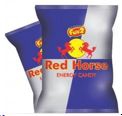
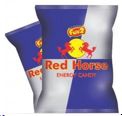
and merely replaced the bulls with horses resulting in the mark to look like: . Bakewell is allegedly selling ‘Energy candies’ under the above mark. Red Bull, in its plaint, also stated that it has ‘Opposed’ Bakewell’s trademark application bearing no. 4327842.
On observing the merits in the case, the Court on May 18, 2021, granted an ex-parte ad-interim injunction against Bakewell retraining them from using the mark
or any other mark deceptively similar to Red Bull’s mark. In view of the restrictions issued due to the ongoing pandemic, the Court has currently not issued directions upon the application for Local Commissioner and has kept it pending for the time being.